WestJet's Wheelchair Weight Cap Was Never About Safety
A 230-kilogram power wheelchair costs $45,000, takes eight months to custom-build, and is the only reason its owner can leave the house. WestJet's cargo floor, the airline said for years, could not safely handle anything over roughly 136 kilograms. The Canadian Transportation Agency just ruled that claim doesn't hold.
The regulator's decision, issued in August 2026, orders WestJet to eliminate weight restrictions on large mobility devices entirely. The airline had defended the cap by pointing to "ultimate load" limits on cargo tie-downs and arguing that heavier chairs posed a structural risk during turbulence or hard landings. The CTA rejected that logic. WestJet operates Boeing 737-800s and 737 MAX 8s. So do Air Canada, Flair, and Porter. None of the others enforce similar weight caps. If the floor can't handle the load, the question becomes: why can WestJet's floor not do what everyone else's floor does?
The airline never proved that carrying a 250-kilogram chair would cause "undue hardship," the legal threshold required under the Accessible Transportation for Persons with Disabilities Regulations. Hardship has to be something more concrete than inconvenience. It means demonstrable safety risk, prohibitive cost, or technical impossibility. WestJet's engineering case didn't clear that bar.
Weight caps serve the airline's scheduling and gate operations, not safety
Weight caps are appealing to airlines because they create a clean sorting rule. A bright line makes gate agents' jobs easier. But bright lines drawn around people's bodies tend to reveal whose convenience the system was designed around in the first place.
Modern power wheelchairs are not standardized. A basic model might weigh 135 kilograms. A chair built for someone with limited upper-body strength, who needs tilt-in-space positioning and environmental controls, can exceed 270 kilograms before you add the batteries. Lithium-ion packs alone can run 35 to 50 kilograms, and Transport Canada classifies anything over 100 watt-hours as dangerous goods requiring special handling. The device is a powered mobility system that medical prescription justifies, not checked baggage.
The CTA's ruling doesn't solve every problem. Physical cargo door dimensions remain a hard limit, if the chair won't fit through the opening even when tilted, the airline isn't required to fly it on that airframe. Ground crew injury risk is real; manually manoeuvring a 500-pound object into a narrow hold without proper lifting equipment is exactly how backs get wrecked. What the ruling does is force airlines to handle those constraints honestly instead of wrapping operational preferences in safety language.
WestJet's defence relied on the idea that the cargo floor's tie-down points have maximum ratings. True. But those ratings describe what the system can handle in a worst-case scenario, not what breaks it under normal use. Every cargo system includes a safety margin. The question the airline couldn't answer: where's the documented case of a properly secured mobility device exceeding the floor's capacity?
What this means for other carriers
The decision sets precedent. Any Canadian airline that tries to implement a similar weight-based exclusion will now face the same burden of proof WestJet couldn't meet. You can't call something a safety protocol unless you can show the engineering that makes it one.
Removing the weight cap doesn't mean every chair flies on every plane. It means airlines have to accommodate the chair unless a specific, provable constraint prevents it, and "our system wasn't designed for this" isn't provable when competitors manage it on identical aircraft. The ruling puts the obligation where it belongs: on the carrier to demonstrate why a device cannot be carried, not on the passenger to prove their chair is light enough to deserve a seat.
WestJet has until before July 2027 to comply. The weight limit is gone. The cargo doors are still 121 centimetres (48 inches) wide.


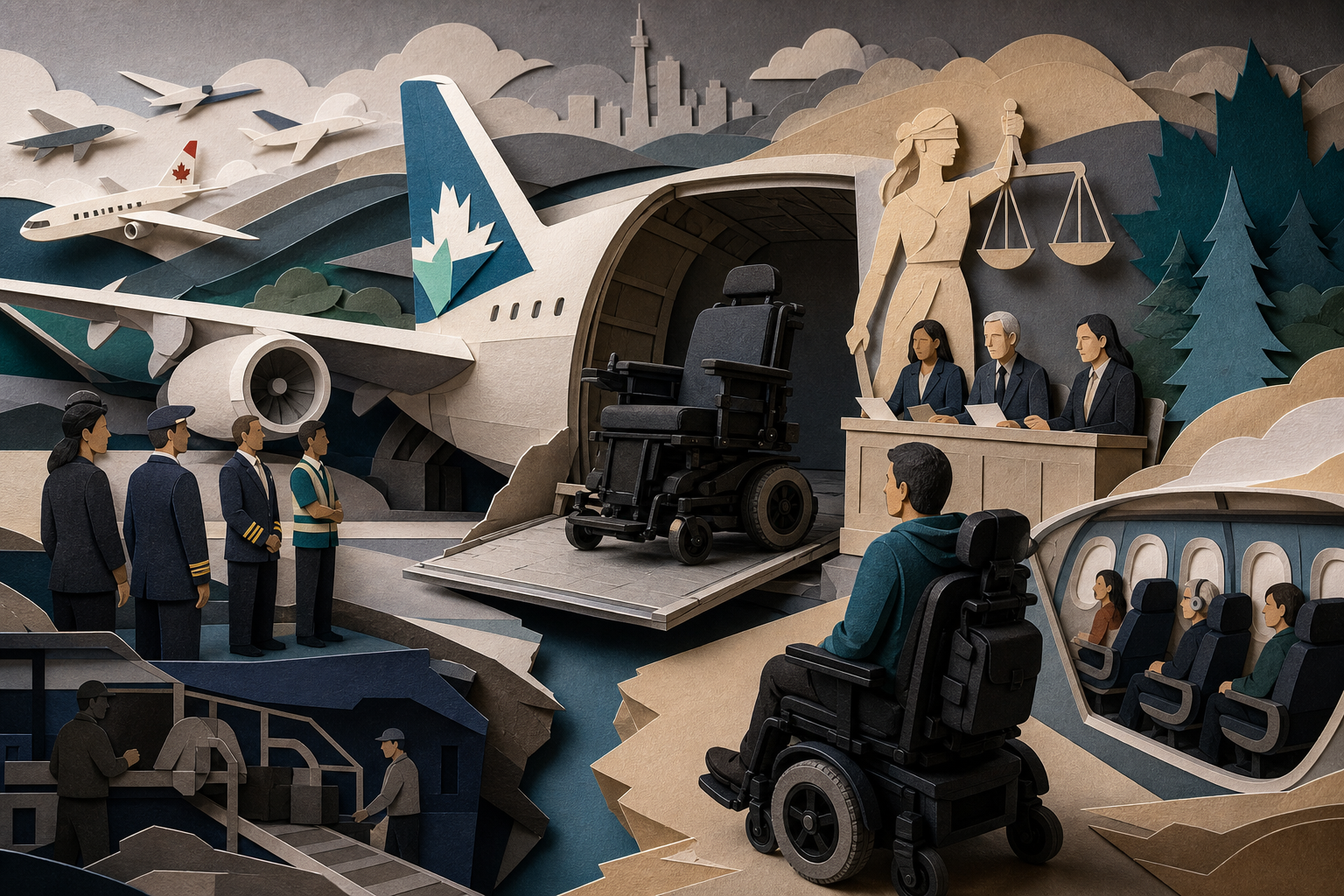

A 230-kilogram power wheelchair costs $45,000, takes eight months to custom-build, and is the only reason its owner can leave the house. WestJet's cargo floor, the airline said for years, could not safely handle anything over roughly 136 kilograms. The Canadian Transportation Agency just ruled that claim doesn't hold.
The regulator's decision, issued in August 2026, orders WestJet to eliminate weight restrictions on large mobility devices entirely. The airline had defended the cap by pointing to "ultimate load" limits on cargo tie-downs and arguing that heavier chairs posed a structural risk during turbulence or hard landings. The CTA rejected that logic. WestJet operates Boeing 737-800s and 737 MAX 8s. So do Air Canada, Flair, and Porter. None of the others enforce similar weight caps. If the floor can't handle the load, the question becomes: why can WestJet's floor not do what everyone else's floor does?
The airline never proved that carrying a 250-kilogram chair would cause "undue hardship," the legal threshold required under the Accessible Transportation for Persons with Disabilities Regulations. Hardship has to be something more concrete than inconvenience. It means demonstrable safety risk, prohibitive cost, or technical impossibility. WestJet's engineering case didn't clear that bar.
Weight caps serve the airline's scheduling and gate operations, not safety
Weight caps are appealing to airlines because they create a clean sorting rule. A bright line makes gate agents' jobs easier. But bright lines drawn around people's bodies tend to reveal whose convenience the system was designed around in the first place.
Modern power wheelchairs are not standardized. A basic model might weigh 135 kilograms. A chair built for someone with limited upper-body strength, who needs tilt-in-space positioning and environmental controls, can exceed 270 kilograms before you add the batteries. Lithium-ion packs alone can run 35 to 50 kilograms, and Transport Canada classifies anything over 100 watt-hours as dangerous goods requiring special handling. The device is a powered mobility system that medical prescription justifies, not checked baggage.
The CTA's ruling doesn't solve every problem. Physical cargo door dimensions remain a hard limit, if the chair won't fit through the opening even when tilted, the airline isn't required to fly it on that airframe. Ground crew injury risk is real; manually manoeuvring a 500-pound object into a narrow hold without proper lifting equipment is exactly how backs get wrecked. What the ruling does is force airlines to handle those constraints honestly instead of wrapping operational preferences in safety language.
WestJet's defence relied on the idea that the cargo floor's tie-down points have maximum ratings. True. But those ratings describe what the system can handle in a worst-case scenario, not what breaks it under normal use. Every cargo system includes a safety margin. The question the airline couldn't answer: where's the documented case of a properly secured mobility device exceeding the floor's capacity?
What this means for other carriers
The decision sets precedent. Any Canadian airline that tries to implement a similar weight-based exclusion will now face the same burden of proof WestJet couldn't meet. You can't call something a safety protocol unless you can show the engineering that makes it one.
Removing the weight cap doesn't mean every chair flies on every plane. It means airlines have to accommodate the chair unless a specific, provable constraint prevents it, and "our system wasn't designed for this" isn't provable when competitors manage it on identical aircraft. The ruling puts the obligation where it belongs: on the carrier to demonstrate why a device cannot be carried, not on the passenger to prove their chair is light enough to deserve a seat.
WestJet has until before July 2027 to comply. The weight limit is gone. The cargo doors are still 121 centimetres (48 inches) wide.
Sources
Read Next
Canadian Homeowners Are Making Higher Payments. Most Still Don't Know What's Coming.
Why a 1,481-Unit Ajax Project Collapsed Before Completion
Ottawa promised tax reform. Experts say three changes matter most.
Why 51% of Your Income Still Buys You a Housing Crisis