Ontario's housing crisis just collided with a power shortage nobody planned for
Hydro One has told developers in parts of southwestern Ontario that it cannot supply power to new subdivisions until at least 2028. The message arrived quietly, in the form of "capacity constraint" notices. No press release. No emergency announcement. Just a technical letter explaining that the local grid is full.
The timing makes this more than an infrastructure hiccup. Ontario committed to building 1.5 million homes by 2031, which works out to roughly 150,000 units per year. The provincial housing mandate assumes land, zoning, labor, and financing will align. It does not assume the lights won't turn on.
The constraint is real, measured, and systemic. The Independent Electricity System Operator projects peak demand will climb by about 2% annually through 2050. That increase reflects electric vehicles, industrial electrification, and the shift away from natural gas heating in new construction. Meanwhile, transmission infrastructure that supplies power to growing suburbs was designed decades ago for populations that no longer match the current build rate.
The Southwest Becomes the Pinch Point
The Windsor-Essex corridor and the outer GTA are seeing the most acute delays. Developers in these regions have won zoning approvals and secured financing, only to discover that the utility cannot deliver enough electricity to support occupancy. In some municipalities, the constraint has created an informal permitting layer: you can get building approval, but you cannot get a connection permit until grid upgrades are complete.
Those upgrades have a 5-to-10-year timeline. Transmission lines require environmental assessments, land acquisition, and coordination across multiple utilities. A high-rise tower can be framed and enclosed in 36 months. The substation that powers it takes longer.
This is not a question of generation capacity alone. Ontario has procured roughly 3,000 MW of battery storage to manage peak load, and the ongoing Bruce Power refurbishment is boosting existing capacity. The problem is the wire, the physical infrastructure that moves electricity from the source to the building. You can add megawatts to the system and still face local bottlenecks if the distribution network cannot handle the draw.
The Policy Collision Nobody Named
Ontario's decarbonization goals encourage all-electric construction. No gas furnaces, no gas water heaters. The省's building code is moving toward net-zero energy performance, which typically means higher electrical loads for heating and cooling. At the same time, every new EV charger in a condo parking garage adds to the building's total demand.
The combined effect is that each new housing unit now requires significantly more electrical capacity than it did a decade ago. A 200-unit building that once needed 1.5 MW might now need 2.5 MW or more, depending on design. Multiply that across 150,000 units per year, and the gap between housing policy and grid planning becomes structural.
The province has responded by fast-tracking natural gas peaker plants to stabilize supply during high-demand periods. Environmental groups have pushed back, arguing that adding gas generation undermines the climate rationale for electrification. The tension is genuine: you can build low-carbon homes, or you can build them quickly with the grid as it exists. Doing both requires infrastructure that does not yet exist at scale.
Developers are adjusting by designing buildings with lower electrical footprints, better insulation, passive solar, on-site generation, not because they are chasing LEED certification, but because it reduces the odds of a rejection letter from the utility. Energy efficiency has shifted from a marketing angle to a prerequisite for project viability.
The housing target remains official policy. The grid constraint remains physical reality. Somewhere between those two facts, the timeline slips.


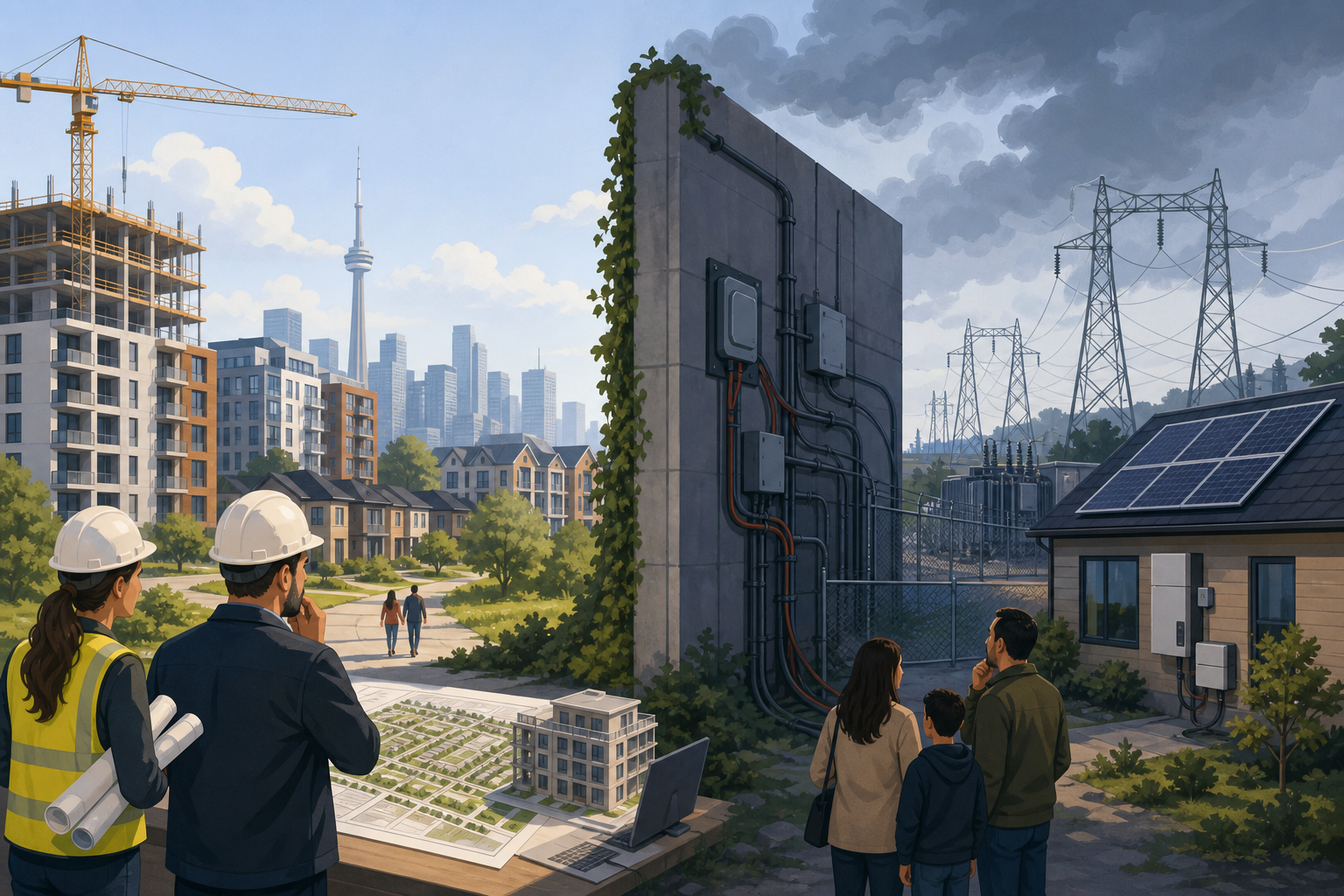

Hydro One has told developers in parts of southwestern Ontario that it cannot supply power to new subdivisions until at least 2028. The message arrived quietly, in the form of "capacity constraint" notices. No press release. No emergency announcement. Just a technical letter explaining that the local grid is full.
The timing makes this more than an infrastructure hiccup. Ontario committed to building 1.5 million homes by 2031, which works out to roughly 150,000 units per year. The provincial housing mandate assumes land, zoning, labor, and financing will align. It does not assume the lights won't turn on.
The constraint is real, measured, and systemic. The Independent Electricity System Operator projects peak demand will climb by about 2% annually through 2050. That increase reflects electric vehicles, industrial electrification, and the shift away from natural gas heating in new construction. Meanwhile, transmission infrastructure that supplies power to growing suburbs was designed decades ago for populations that no longer match the current build rate.
The Southwest Becomes the Pinch Point
The Windsor-Essex corridor and the outer GTA are seeing the most acute delays. Developers in these regions have won zoning approvals and secured financing, only to discover that the utility cannot deliver enough electricity to support occupancy. In some municipalities, the constraint has created an informal permitting layer: you can get building approval, but you cannot get a connection permit until grid upgrades are complete.
Those upgrades have a 5-to-10-year timeline. Transmission lines require environmental assessments, land acquisition, and coordination across multiple utilities. A high-rise tower can be framed and enclosed in 36 months. The substation that powers it takes longer.
This is not a question of generation capacity alone. Ontario has procured roughly 3,000 MW of battery storage to manage peak load, and the ongoing Bruce Power refurbishment is boosting existing capacity. The problem is the wire, the physical infrastructure that moves electricity from the source to the building. You can add megawatts to the system and still face local bottlenecks if the distribution network cannot handle the draw.
The Policy Collision Nobody Named
Ontario's decarbonization goals encourage all-electric construction. No gas furnaces, no gas water heaters. The省's building code is moving toward net-zero energy performance, which typically means higher electrical loads for heating and cooling. At the same time, every new EV charger in a condo parking garage adds to the building's total demand.
The combined effect is that each new housing unit now requires significantly more electrical capacity than it did a decade ago. A 200-unit building that once needed 1.5 MW might now need 2.5 MW or more, depending on design. Multiply that across 150,000 units per year, and the gap between housing policy and grid planning becomes structural.
The province has responded by fast-tracking natural gas peaker plants to stabilize supply during high-demand periods. Environmental groups have pushed back, arguing that adding gas generation undermines the climate rationale for electrification. The tension is genuine: you can build low-carbon homes, or you can build them quickly with the grid as it exists. Doing both requires infrastructure that does not yet exist at scale.
Developers are adjusting by designing buildings with lower electrical footprints, better insulation, passive solar, on-site generation, not because they are chasing LEED certification, but because it reduces the odds of a rejection letter from the utility. Energy efficiency has shifted from a marketing angle to a prerequisite for project viability.
The housing target remains official policy. The grid constraint remains physical reality. Somewhere between those two facts, the timeline slips.
Sources
Read Next
Canadian Homeowners Are Making Higher Payments. Most Still Don't Know What's Coming.
WestJet's Wheelchair Weight Cap Was Never About Safety
Why a 1,481-Unit Ajax Project Collapsed Before Completion
Ottawa promised tax reform. Experts say three changes matter most.