Iowa Voters Split on Trump's Canada Tariffs as GOP Contenders Navigate Trade Loyalty Test
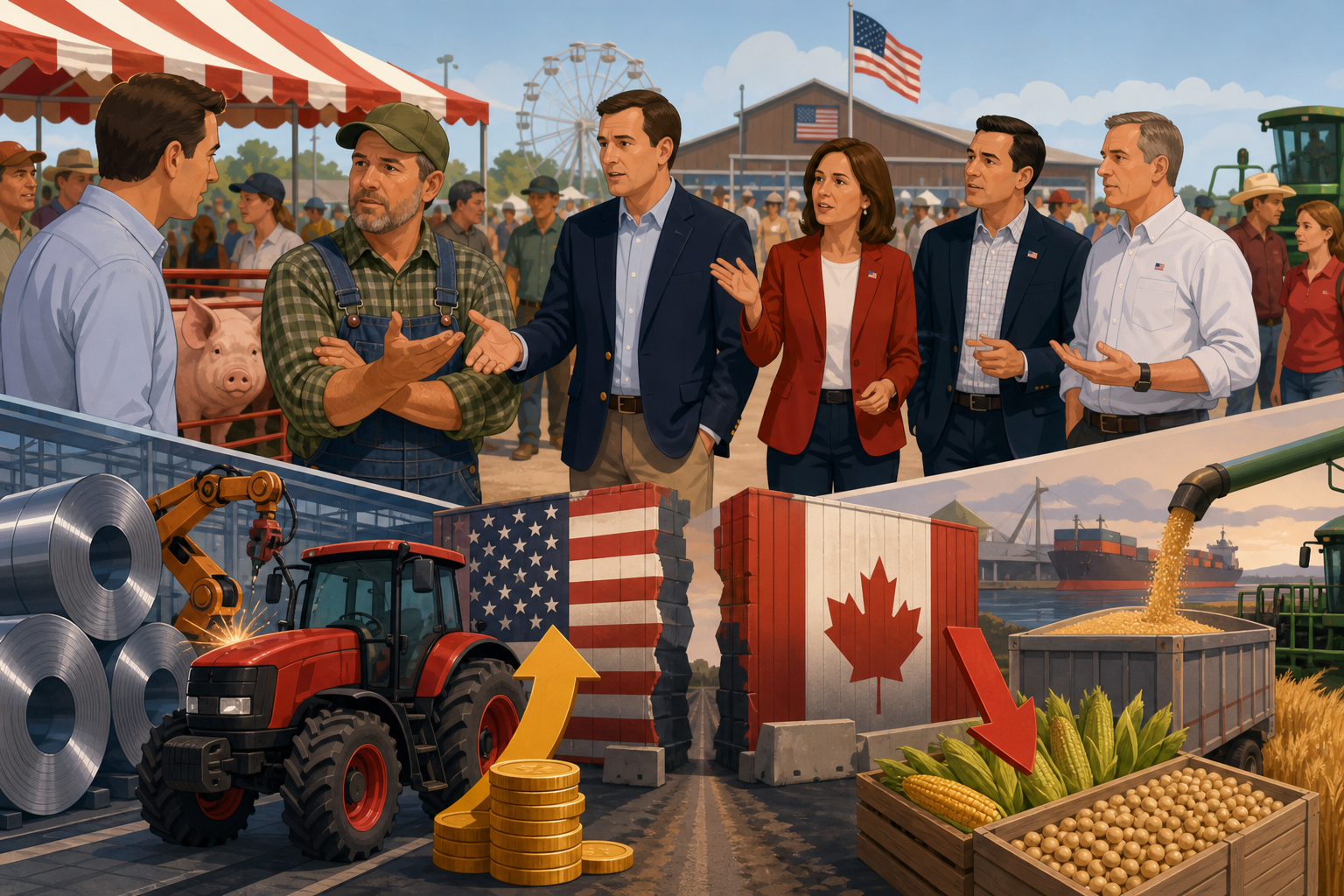
At the Pork Tent on the Iowa State Fairgrounds, a fifth-generation corn farmer from Story County says he supports getting tough on Canada, then pauses when asked if he's ready for Ottawa to slap retaliatory tariffs on the 2.7 billion bushels his state grows every year. "Well, that's different," he says.
That's the problem Republicans are running into as the 2026 midterms approach. Iowa voters like the idea of Trump's proposed reciprocal tariffs on Canada. They're less enthusiastic about what happens when Canada fires back.
The loyalty test with a footnote
GOP candidates walking the fairgrounds this August are being graded on a single question: do you back Trump's trade framework, yes or no? The safe answer is yes. The honest answer requires a longer sentence, and longer sentences don't play well at a state fair.
The proposed tariffs, framed under what Trump calls the Reciprocal Trade Act, would match Canadian duties one-for-one, targeting dairy quotas and softwood lumber restrictions. On paper, it's a clean pitch. In practice, it's a framework that turns Iowa's largest export market into a combatant.
Canada bought 30% of Iowa's international exports in 2025. Corn, pork, and farm machinery. John Deere's supply chain runs through Ontario and Quebec. A full-blown trade war doesn't just hurt the farmer. It raises the price of the tractor he needs to plant next spring.
That creates an internal fracture for candidates. Backing the tariffs signals loyalty to Trump's base. Questioning them opens the door to attack ads about being soft on trade. The result is a rhetorical tightrope act: praise the president's toughness, add a vague qualifier about making sure farmers don't get hurt, move to the next tent.
The USMCA review as accelerant
The United States-Mexico-Canada Agreement hits its six-year review in 2026, and that deadline is being weaponized. Candidates are using it to demand concessions from Canada on dairy and automotive rules of origin, framing any pushback as evidence that the northern neighbor has been taking advantage all along.
Voters hear "renegotiate" and nod. What they're not hearing is that renegotiation in the middle of a tariff fight rarely produces better terms. It produces uncertainty, and uncertainty in agriculture means delayed capital investment and suppressed commodity prices.
A hog producer outside Des Moines put it plainly: "I want a better deal. I don't want no deal."
The machinery problem nobody's solving
Here's the contradiction candidates aren't addressing. High steel tariffs, which Trump has floated as part of a broader protectionist package, would protect domestic metal production. They would also raise the cost of manufacturing farm equipment, which Iowa buys in volume.
The farmer benefits from tariffs on foreign steel, until he goes to finance a new combine and discovers the price went up $40,000. At that point, the tariff that was supposed to protect American industry is just a tax on the person it was meant to help.
Federal aid packages, like the $28 billion bailout deployed during the 2018-2019 trade war, can offset some of that pain. But subsidy dependence is not the pitch Republicans want to make in a state that still views itself as self-reliant.
What the fair actually shows
The Iowa State Fair draws over a million people, and the political sample it provides is harder to spin than a poll. What it's showing this year is that Iowa voters want toughness on trade, but toughness defined as "better deals," not "scorched-earth tariff escalation."
Candidates who can articulate that distinction might survive the loyalty test. The ones just parroting "reciprocal" and hoping nobody asks about pork exports are going to have a harder August than they planned.



At the Pork Tent on the Iowa State Fairgrounds, a fifth-generation corn farmer from Story County says he supports getting tough on Canada, then pauses when asked if he's ready for Ottawa to slap retaliatory tariffs on the 2.7 billion bushels his state grows every year. "Well, that's different," he says.
That's the problem Republicans are running into as the 2026 midterms approach. Iowa voters like the idea of Trump's proposed reciprocal tariffs on Canada. They're less enthusiastic about what happens when Canada fires back.
The loyalty test with a footnote
GOP candidates walking the fairgrounds this August are being graded on a single question: do you back Trump's trade framework, yes or no? The safe answer is yes. The honest answer requires a longer sentence, and longer sentences don't play well at a state fair.
The proposed tariffs, framed under what Trump calls the Reciprocal Trade Act, would match Canadian duties one-for-one, targeting dairy quotas and softwood lumber restrictions. On paper, it's a clean pitch. In practice, it's a framework that turns Iowa's largest export market into a combatant.
Canada bought 30% of Iowa's international exports in 2025. Corn, pork, and farm machinery. John Deere's supply chain runs through Ontario and Quebec. A full-blown trade war doesn't just hurt the farmer. It raises the price of the tractor he needs to plant next spring.
That creates an internal fracture for candidates. Backing the tariffs signals loyalty to Trump's base. Questioning them opens the door to attack ads about being soft on trade. The result is a rhetorical tightrope act: praise the president's toughness, add a vague qualifier about making sure farmers don't get hurt, move to the next tent.
The USMCA review as accelerant
The United States-Mexico-Canada Agreement hits its six-year review in 2026, and that deadline is being weaponized. Candidates are using it to demand concessions from Canada on dairy and automotive rules of origin, framing any pushback as evidence that the northern neighbor has been taking advantage all along.
Voters hear "renegotiate" and nod. What they're not hearing is that renegotiation in the middle of a tariff fight rarely produces better terms. It produces uncertainty, and uncertainty in agriculture means delayed capital investment and suppressed commodity prices.
A hog producer outside Des Moines put it plainly: "I want a better deal. I don't want no deal."
The machinery problem nobody's solving
Here's the contradiction candidates aren't addressing. High steel tariffs, which Trump has floated as part of a broader protectionist package, would protect domestic metal production. They would also raise the cost of manufacturing farm equipment, which Iowa buys in volume.
The farmer benefits from tariffs on foreign steel, until he goes to finance a new combine and discovers the price went up $40,000. At that point, the tariff that was supposed to protect American industry is just a tax on the person it was meant to help.
Federal aid packages, like the $28 billion bailout deployed during the 2018-2019 trade war, can offset some of that pain. But subsidy dependence is not the pitch Republicans want to make in a state that still views itself as self-reliant.
What the fair actually shows
The Iowa State Fair draws over a million people, and the political sample it provides is harder to spin than a poll. What it's showing this year is that Iowa voters want toughness on trade, but toughness defined as "better deals," not "scorched-earth tariff escalation."
Candidates who can articulate that distinction might survive the loyalty test. The ones just parroting "reciprocal" and hoping nobody asks about pork exports are going to have a harder August than they planned.
Sources
Read Next
Canadian Homeowners Are Making Higher Payments. Most Still Don't Know What's Coming.
WestJet's Wheelchair Weight Cap Was Never About Safety
Why a 1,481-Unit Ajax Project Collapsed Before Completion
Ottawa promised tax reform. Experts say three changes matter most.