Why the Bank of Canada's Next Rate Decision Is Easier Than It Looks
Why the Bank of Canada's Next Rate Decision Is Easier Than It Looks
The overnight rate has been sitting above 4% for eighteen months. That's a level economists once warned would snap the Canadian economy in half. It didn't.
What happened instead is that the dilemma central bankers actually lose sleep over, the choice between crushing inflation and triggering mass unemployment, dissolved on its own. Inflation is back inside the 1% to 3% target band. The labor market cooled without collapsing. Governor Tiff Macklem will almost certainly hold rates at the July meeting, not because he's making a difficult judgment call, but because the conditions that made previous decisions agonizing no longer apply.
The crisis that didn't arrive
Recession forecasts in late 2024 were near-universal. High rates were supposed to choke off consumer spending, crater the housing market, and send unemployment past 7%. The mechanism was straightforward: Canadians carry more household debt relative to income than nearly any other developed nation, most of it tied to mortgages. When rates rise, debt service costs rise, discretionary spending falls, and the contraction spreads.
That contraction never materialized at scale. GDP growth has been weak, somewhere between 1.2% and 1.5% for 2026, but positive. Unemployment is in the low-6% range, which is higher than the 5.2% lows of 2022 but nowhere near the 8% threshold that signals widespread distress. The wave of mortgage renewals that was supposed to act as a detonator turned out to be more like a slow leak. Borrowers who locked in 1.79% five-year rates in 2021 are renewing at 5%, which hurts, but most are absorbing the hit by cutting other spending rather than defaulting. That creates drag, not crisis.
The Bank's risk calculus has shifted. A year ago, holding rates steady meant gambling that inflation wouldn't re-accelerate. Cutting meant gambling that the economy could handle one more quarter of restriction without tipping into recession. Now both variables have stabilized enough that doing nothing is the lowest-risk move available.
What "neutral" actually means
Central bankers talk about the neutral rate as if it's a known quantity. It isn't. The neutral rate is the interest rate that neither speeds up nor slows down the economy, the level at which monetary policy is doing nothing except maintaining equilibrium. The problem is that you can only know where neutral was after the fact, by watching what happened when you held rates at a given level for long enough to see the effects.
The current rate is still considered restrictive, meaning it's above neutral and designed to suppress demand. But the distance between where rates are now and where neutral sits has narrowed. Inflation near the 2% midpoint suggests the restrictive pressure is working without overcorrecting. The labor market holding steady suggests the economy can tolerate this level without breaking. If those conditions persist, the Bank doesn't need to do anything except wait for the lagged effects of past hikes to finish working through the system.
Monetary policy operates on long and variable lags. A rate hike takes 12 to 18 months to fully ripple through consumer behavior, business investment, and hiring decisions. The hikes from 2023 and early 2024 are still transmitting. Holding now isn't inaction. It's letting the previous moves finish.
The mortgage cliff is real but slow
The renewal wave is not over. Roughly 45% of Canadian mortgages are set to renew between now and the end of 2027, and most of those borrowers are moving from sub-2% rates to something closer to 5%. That's a structural headwind the Bank cannot ignore, even as the immediate recession risk fades.
The difference is timing. A sudden economic shock, an oil price spike, a U.S. downturn, a financial system failure, forces central banks to move fast. A rolling wave of mortgage renewals creates gradual pressure that can be managed with patience. The July hold signals that the Bank believes patience is the right tool for the current conditions.
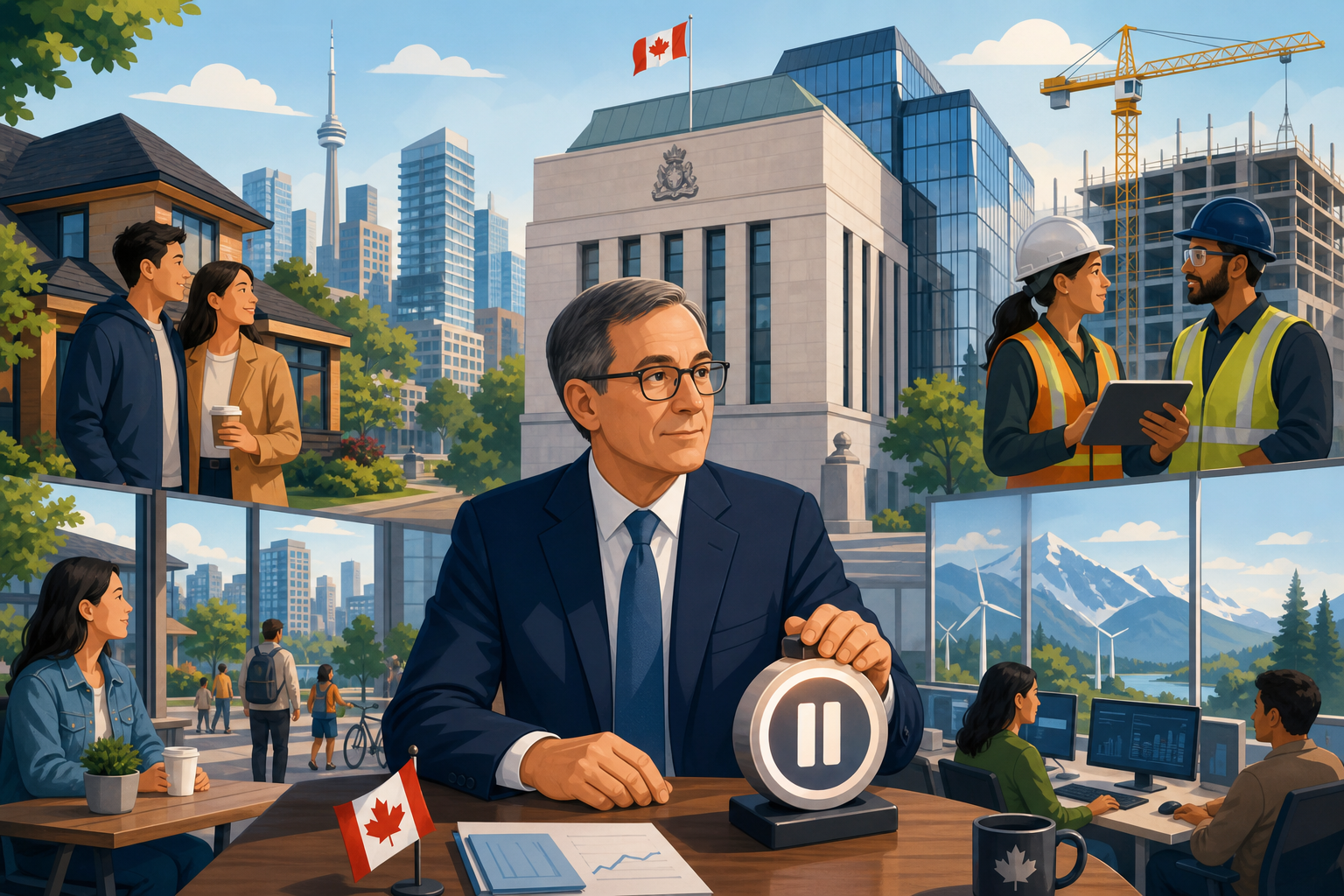
What looks like a difficult decision from the outside is actually the easiest call Macklem has faced in two years. The economy isn't strong, but it isn't collapsing. Inflation isn't beaten, but it isn't surging. The choice is to hold and let the system stabilize. That's not a dilemma. It's a gift.



Why the Bank of Canada's Next Rate Decision Is Easier Than It Looks
The overnight rate has been sitting above 4% for eighteen months. That's a level economists once warned would snap the Canadian economy in half. It didn't.
What happened instead is that the dilemma central bankers actually lose sleep over, the choice between crushing inflation and triggering mass unemployment, dissolved on its own. Inflation is back inside the 1% to 3% target band. The labor market cooled without collapsing. Governor Tiff Macklem will almost certainly hold rates at the July meeting, not because he's making a difficult judgment call, but because the conditions that made previous decisions agonizing no longer apply.
The crisis that didn't arrive
Recession forecasts in late 2024 were near-universal. High rates were supposed to choke off consumer spending, crater the housing market, and send unemployment past 7%. The mechanism was straightforward: Canadians carry more household debt relative to income than nearly any other developed nation, most of it tied to mortgages. When rates rise, debt service costs rise, discretionary spending falls, and the contraction spreads.
That contraction never materialized at scale. GDP growth has been weak, somewhere between 1.2% and 1.5% for 2026, but positive. Unemployment is in the low-6% range, which is higher than the 5.2% lows of 2022 but nowhere near the 8% threshold that signals widespread distress. The wave of mortgage renewals that was supposed to act as a detonator turned out to be more like a slow leak. Borrowers who locked in 1.79% five-year rates in 2021 are renewing at 5%, which hurts, but most are absorbing the hit by cutting other spending rather than defaulting. That creates drag, not crisis.
The Bank's risk calculus has shifted. A year ago, holding rates steady meant gambling that inflation wouldn't re-accelerate. Cutting meant gambling that the economy could handle one more quarter of restriction without tipping into recession. Now both variables have stabilized enough that doing nothing is the lowest-risk move available.
What "neutral" actually means
Central bankers talk about the neutral rate as if it's a known quantity. It isn't. The neutral rate is the interest rate that neither speeds up nor slows down the economy, the level at which monetary policy is doing nothing except maintaining equilibrium. The problem is that you can only know where neutral was after the fact, by watching what happened when you held rates at a given level for long enough to see the effects.
The current rate is still considered restrictive, meaning it's above neutral and designed to suppress demand. But the distance between where rates are now and where neutral sits has narrowed. Inflation near the 2% midpoint suggests the restrictive pressure is working without overcorrecting. The labor market holding steady suggests the economy can tolerate this level without breaking. If those conditions persist, the Bank doesn't need to do anything except wait for the lagged effects of past hikes to finish working through the system.
Monetary policy operates on long and variable lags. A rate hike takes 12 to 18 months to fully ripple through consumer behavior, business investment, and hiring decisions. The hikes from 2023 and early 2024 are still transmitting. Holding now isn't inaction. It's letting the previous moves finish.
The mortgage cliff is real but slow
The renewal wave is not over. Roughly 45% of Canadian mortgages are set to renew between now and the end of 2027, and most of those borrowers are moving from sub-2% rates to something closer to 5%. That's a structural headwind the Bank cannot ignore, even as the immediate recession risk fades.
The difference is timing. A sudden economic shock, an oil price spike, a U.S. downturn, a financial system failure, forces central banks to move fast. A rolling wave of mortgage renewals creates gradual pressure that can be managed with patience. The July hold signals that the Bank believes patience is the right tool for the current conditions.
What looks like a difficult decision from the outside is actually the easiest call Macklem has faced in two years. The economy isn't strong, but it isn't collapsing. Inflation isn't beaten, but it isn't surging. The choice is to hold and let the system stabilize. That's not a dilemma. It's a gift.
Read Next
DLC Now Controls Both Filogix and Velocity: Why That Should Worry Every Independent Broker
MCAN's 19% earnings jump proves mortgage impairments aren't the risk signal investors think they are
Toronto Buyers Can Stop Writing Love Letters, The Market Already Did the Work
25 States Sue Trump Over Tariffs, Claiming Presidential Overreach on Import Taxes