What a 50% Tariff Does to Supply Chains Built Around Zero
A vehicle bumper manufactured in Windsor crosses into Michigan, gets powder-coated, returns to Ontario for sub-assembly, crosses again for final integration, then ships to a Texas dealership. Seven border crossings, total tariff exposure under USMCA: zero. Under a 50% levy, that same bumper now carries compounding taxes at each crossing, not once, but potentially multiple times if every trip triggers the rate.
This is what breaks first. Not the politics or the posturing, but the industrial choreography that was designed around friction being nearly free.
The Zero-Tariff Assumption
Most Canada-U.S. supply chains were not built to tolerate tariffs. They were built to exploit their absence. The automotive sector is the clearest example: a single vehicle contains components that cross the border an average of seven times before final assembly. Under USMCA, those crossings cost nothing in duties. Under a 50% tariff regime, the cost structure collapses. Even if the tariff applies only at final import, the Price Floor Problem appears, every input sourced from Canada now carries a 50% load, and downstream manufacturers either eat the cost (impossible at that scale) or pass it through to consumers, triggering an inflationary spike in categories that were stable for decades.
Canada supplies roughly 60% of U.S. crude oil imports, 4 million barrels per day, most of it heavy crude optimized for Midwest refineries. A 50% tariff on oil doesn't "reshore" refining capacity. It makes existing refineries uncompetitive with their own feedstock. The U.S. lacks sufficient domestic heavy crude to replace Canadian volumes, and sourcing alternative supplies from overseas (Venezuela, Saudi Arabia) would require costly refinery retrofits and expose supply lines to geopolitical instability the Canadian pipeline network avoids. The "energy independence" framing inverts: taxing the most stable, proximate supply at 50% creates dependence on less stable, more expensive alternatives.
The Retaliation Spiral
Canada's retaliatory playbook is well-established. During the 2018 steel and aluminum tariffs, Ottawa imposed dollar-for-dollar countermeasures targeting politically sensitive U.S. exports: bourbon from Kentucky, motorcycles from Wisconsin, steel from Pennsylvania. A 50% tariff from Washington will trigger a similar response, but at a scale that affects $3.5 billion in daily cross-border trade. The asymmetry matters here, Canada sends 75% of its exports to the U.S., but those exports are concentrated in categories (energy, autos, building materials) where U.S. demand is inelastic. Retaliatory tariffs hit U.S. exporters in sectors where Canada has alternatives or can absorb the loss more easily than the U.S. can replace Canadian inputs.
Lumber is another flashpoint. Canadian softwood accounts for roughly one-third of U.S. supply. Tariffing it at 50% doesn't increase U.S. lumber production in any meaningful timeframe, it increases the cost of homebuilding in states already facing housing shortages. The beneficiaries are not American sawmills (which lack spare capacity), but overseas exporters in Europe and South America, who will step in at prices below the tariff-loaded Canadian rate but still higher than the pre-tariff baseline.
What Breaks When Certainty Disappears
The USMCA review clause scheduled for 2026 was designed as a stability check. Using it as leverage to impose a 50% tariff before that review date turns the agreement into a rolling negotiation. Suppliers cannot invest in cross-border facilities when the cost structure might double on a week's notice. The Great Lakes manufacturing corridor, which functions as a single integrated economy spanning Ontario, Michigan, and Ohio, depends on predictability more than it depends on any single tariff rate. A 50% levy that might be rescinded in six months if Canada offers concessions on dairy or digital services taxes is worse than a permanent 10% tariff, because no one can model it.
The supply chains built around zero were not assuming goodwill. They were assuming math.


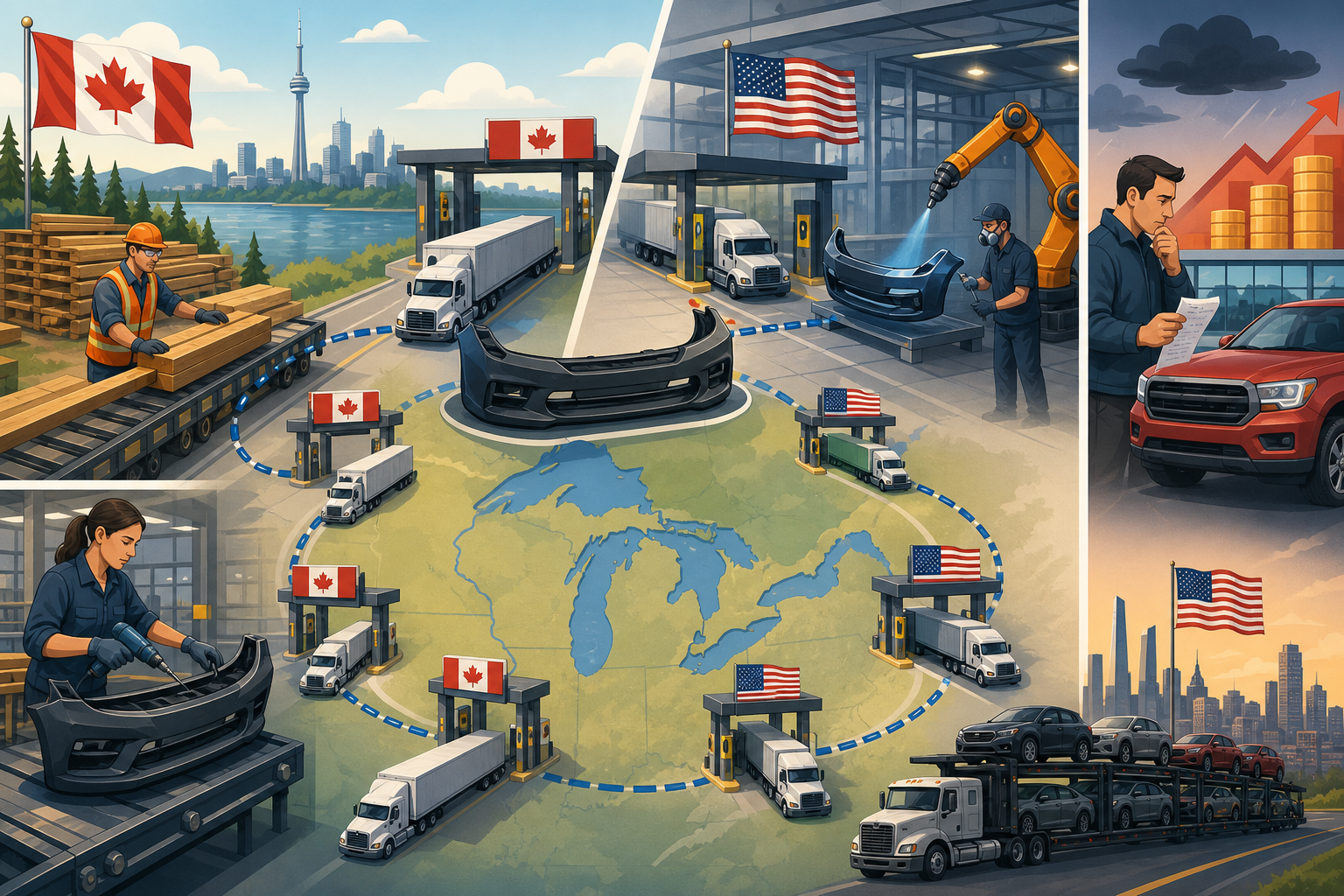

A vehicle bumper manufactured in Windsor crosses into Michigan, gets powder-coated, returns to Ontario for sub-assembly, crosses again for final integration, then ships to a Texas dealership. Seven border crossings, total tariff exposure under USMCA: zero. Under a 50% levy, that same bumper now carries compounding taxes at each crossing, not once, but potentially multiple times if every trip triggers the rate.
This is what breaks first. Not the politics or the posturing, but the industrial choreography that was designed around friction being nearly free.
The Zero-Tariff Assumption
Most Canada-U.S. supply chains were not built to tolerate tariffs. They were built to exploit their absence. The automotive sector is the clearest example: a single vehicle contains components that cross the border an average of seven times before final assembly. Under USMCA, those crossings cost nothing in duties. Under a 50% tariff regime, the cost structure collapses. Even if the tariff applies only at final import, the Price Floor Problem appears, every input sourced from Canada now carries a 50% load, and downstream manufacturers either eat the cost (impossible at that scale) or pass it through to consumers, triggering an inflationary spike in categories that were stable for decades.
Canada supplies roughly 60% of U.S. crude oil imports, 4 million barrels per day, most of it heavy crude optimized for Midwest refineries. A 50% tariff on oil doesn't "reshore" refining capacity. It makes existing refineries uncompetitive with their own feedstock. The U.S. lacks sufficient domestic heavy crude to replace Canadian volumes, and sourcing alternative supplies from overseas (Venezuela, Saudi Arabia) would require costly refinery retrofits and expose supply lines to geopolitical instability the Canadian pipeline network avoids. The "energy independence" framing inverts: taxing the most stable, proximate supply at 50% creates dependence on less stable, more expensive alternatives.
The Retaliation Spiral
Canada's retaliatory playbook is well-established. During the 2018 steel and aluminum tariffs, Ottawa imposed dollar-for-dollar countermeasures targeting politically sensitive U.S. exports: bourbon from Kentucky, motorcycles from Wisconsin, steel from Pennsylvania. A 50% tariff from Washington will trigger a similar response, but at a scale that affects $3.5 billion in daily cross-border trade. The asymmetry matters here, Canada sends 75% of its exports to the U.S., but those exports are concentrated in categories (energy, autos, building materials) where U.S. demand is inelastic. Retaliatory tariffs hit U.S. exporters in sectors where Canada has alternatives or can absorb the loss more easily than the U.S. can replace Canadian inputs.
Lumber is another flashpoint. Canadian softwood accounts for roughly one-third of U.S. supply. Tariffing it at 50% doesn't increase U.S. lumber production in any meaningful timeframe, it increases the cost of homebuilding in states already facing housing shortages. The beneficiaries are not American sawmills (which lack spare capacity), but overseas exporters in Europe and South America, who will step in at prices below the tariff-loaded Canadian rate but still higher than the pre-tariff baseline.
What Breaks When Certainty Disappears
The USMCA review clause scheduled for 2026 was designed as a stability check. Using it as leverage to impose a 50% tariff before that review date turns the agreement into a rolling negotiation. Suppliers cannot invest in cross-border facilities when the cost structure might double on a week's notice. The Great Lakes manufacturing corridor, which functions as a single integrated economy spanning Ontario, Michigan, and Ohio, depends on predictability more than it depends on any single tariff rate. A 50% levy that might be rescinded in six months if Canada offers concessions on dairy or digital services taxes is worse than a permanent 10% tariff, because no one can model it.
The supply chains built around zero were not assuming goodwill. They were assuming math.
Read Next
DLC Now Controls Both Filogix and Velocity: Why That Should Worry Every Independent Broker
MCAN's 19% earnings jump proves mortgage impairments aren't the risk signal investors think they are
Toronto Buyers Can Stop Writing Love Letters, The Market Already Did the Work
25 States Sue Trump Over Tariffs, Claiming Presidential Overreach on Import Taxes