Trump Defends Tariffs in Michigan as Gordie Howe Bridge Opening Exposes Canada-US Friction
The President stood before a crowd in Warren, Michigan, on Tuesday to sell a hard line on trade, the same day a quarter-billion-dollar bridge meant to ease the flow of goods between two countries officially opened 40 miles south. The timing wasn't accidental. It was a collision.
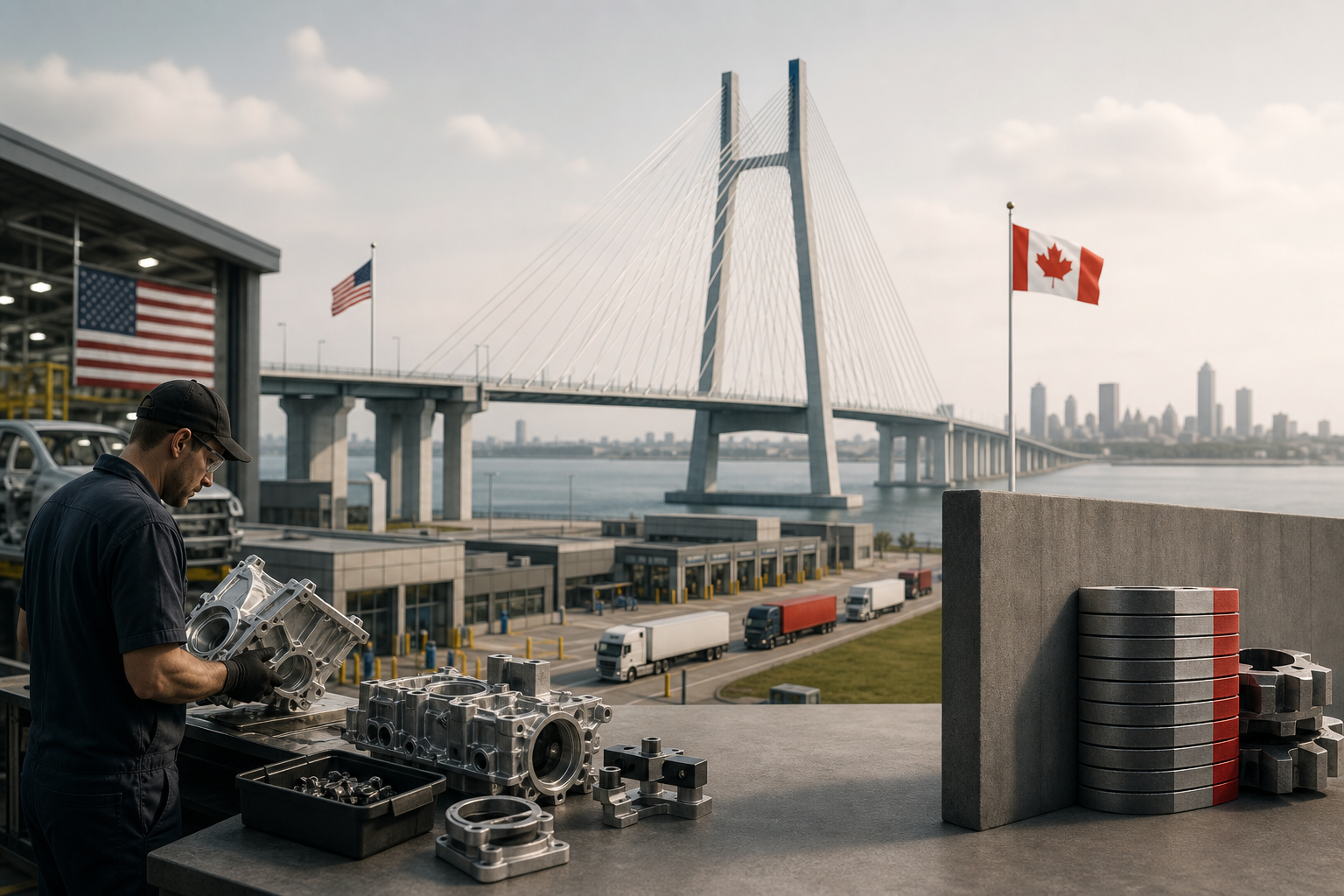
The Gordie Howe International Bridge connects Detroit to Windsor, Ontario, across the busiest commercial corridor in North America. It features a 167-acre Canadian port of entry, a 148-acre U.S. facility, and infrastructure designed to handle 25% of all surface trade between the two nations. Canada financed most of the construction. The structure is a monument to integration, built on the assumption that barriers would shrink, not grow.
Instead, Washington has imposed or proposed tariffs ranging from 10% on aluminum to 25% on steel and automotive parts. The automotive sector represents roughly one-third of Michigan's imports from Canada. Modern vehicle assembly involves components crossing the border up to seven times before final installation. Each crossing now incurs a tax.
The Friction Beneath the Ribbon-Cutting
The bridge's opening ceremony, scheduled for weeks, became a diplomatic event with visible cracks. Canadian officials attended. U.S. federal representation was minimal. The contrast was noted in both capitals, and the symbolism wasn't subtle: a physical link inaugurated while the political will to use it erodes.
For Michigan manufacturers operating on just-in-time delivery schedules, the policy shift creates compounding costs. A 5% price increase or a 24-hour delay at the border can halt production lines in Flint, Detroit, and Lansing. The bridge reduces idling time and emissions, but tariffs may reduce the volume of freight moving across it, raising questions about the return on a multi-billion-dollar investment in an era of protectionism.
The state's economy is built on specialization. Southern Ontario handles tooling and precision parts that Michigan firms struggled to replace when tariff threats first emerged in 2018, and the pattern repeated in 2025. Long-term contracts and specialized equipment make decoupling expensive and slow. The President's framing positions tariffs as a tool to force reshoring. Industry analysts note the timeline for building equivalent domestic capacity runs in years, not quarters.
Ottawa's Measured Retaliation
Canada has responded to prior U.S. tariffs with dollar-for-dollar countermeasures, often targeting politically sensitive exports: dairy, bourbon, prepared foods. The strategy is calibration, not escalation, designed to apply pressure in swing states without triggering a broader rupture.
That calculus becomes harder when the tariffs hit the core of the integrated supply chain. Roughly 60% of Canadian exports to the U.S. are intermediate goods used in American manufacturing. A tariff on Canadian steel isn't a tax on Canada. It's a tax on the Michigan automaker buying the steel.
The political logic, from Washington's perspective, is optics over optimization. The message to voters is simple: America first, borders matter, concessions extracted. The message to manufacturers is more complex and less flattering. Short-term pain is framed as necessary to rebuild domestic capacity. But capacity isn't built by announcement. It requires capital, labor, and time, none of which tariffs supply.
What Wins and What Doesn't
Primary U.S. metal producers may see increased demand and pricing power. That creates a split in the domestic manufacturing lobby between raw material suppliers and finished goods producers. The automotive and aerospace sectors face higher input costs. The constituency for tariffs isn't monolithic, and the geographic distribution of costs and benefits matters in a battleground state.
The bridge will carry freight regardless. The question is how much, at what cost, and whether the policy environment will treat the corridor as an asset or a point of leverage. Infrastructure and policy rarely move in sync, but when they move in opposite directions, it's the policy that determines what the infrastructure is worth.



The President stood before a crowd in Warren, Michigan, on Tuesday to sell a hard line on trade, the same day a quarter-billion-dollar bridge meant to ease the flow of goods between two countries officially opened 40 miles south. The timing wasn't accidental. It was a collision.
The Gordie Howe International Bridge connects Detroit to Windsor, Ontario, across the busiest commercial corridor in North America. It features a 167-acre Canadian port of entry, a 148-acre U.S. facility, and infrastructure designed to handle 25% of all surface trade between the two nations. Canada financed most of the construction. The structure is a monument to integration, built on the assumption that barriers would shrink, not grow.
Instead, Washington has imposed or proposed tariffs ranging from 10% on aluminum to 25% on steel and automotive parts. The automotive sector represents roughly one-third of Michigan's imports from Canada. Modern vehicle assembly involves components crossing the border up to seven times before final installation. Each crossing now incurs a tax.
The Friction Beneath the Ribbon-Cutting
The bridge's opening ceremony, scheduled for weeks, became a diplomatic event with visible cracks. Canadian officials attended. U.S. federal representation was minimal. The contrast was noted in both capitals, and the symbolism wasn't subtle: a physical link inaugurated while the political will to use it erodes.
For Michigan manufacturers operating on just-in-time delivery schedules, the policy shift creates compounding costs. A 5% price increase or a 24-hour delay at the border can halt production lines in Flint, Detroit, and Lansing. The bridge reduces idling time and emissions, but tariffs may reduce the volume of freight moving across it, raising questions about the return on a multi-billion-dollar investment in an era of protectionism.
The state's economy is built on specialization. Southern Ontario handles tooling and precision parts that Michigan firms struggled to replace when tariff threats first emerged in 2018, and the pattern repeated in 2025. Long-term contracts and specialized equipment make decoupling expensive and slow. The President's framing positions tariffs as a tool to force reshoring. Industry analysts note the timeline for building equivalent domestic capacity runs in years, not quarters.
Ottawa's Measured Retaliation
Canada has responded to prior U.S. tariffs with dollar-for-dollar countermeasures, often targeting politically sensitive exports: dairy, bourbon, prepared foods. The strategy is calibration, not escalation, designed to apply pressure in swing states without triggering a broader rupture.
That calculus becomes harder when the tariffs hit the core of the integrated supply chain. Roughly 60% of Canadian exports to the U.S. are intermediate goods used in American manufacturing. A tariff on Canadian steel isn't a tax on Canada. It's a tax on the Michigan automaker buying the steel.
The political logic, from Washington's perspective, is optics over optimization. The message to voters is simple: America first, borders matter, concessions extracted. The message to manufacturers is more complex and less flattering. Short-term pain is framed as necessary to rebuild domestic capacity. But capacity isn't built by announcement. It requires capital, labor, and time, none of which tariffs supply.
What Wins and What Doesn't
Primary U.S. metal producers may see increased demand and pricing power. That creates a split in the domestic manufacturing lobby between raw material suppliers and finished goods producers. The automotive and aerospace sectors face higher input costs. The constituency for tariffs isn't monolithic, and the geographic distribution of costs and benefits matters in a battleground state.
The bridge will carry freight regardless. The question is how much, at what cost, and whether the policy environment will treat the corridor as an asset or a point of leverage. Infrastructure and policy rarely move in sync, but when they move in opposite directions, it's the policy that determines what the infrastructure is worth.
Read Next
MCAN's 19% earnings jump proves mortgage impairments aren't the risk signal investors think they are
Toronto Buyers Can Stop Writing Love Letters, The Market Already Did the Work
25 States Sue Trump Over Tariffs, Claiming Presidential Overreach on Import Taxes
Carney's Alberta housing pitch meets canola fields and separatist flags