Pigeon Netting Works, But Should You Use It? Ranking Six Balcony Deterrents by Effectiveness and Ethics
A unit on the 14th floor of a King West condo sold for $38,000 under asking last spring. The listing looked fine until the viewing. The balcony was covered in droppings, the railing corners packed with nesting debris. The buyer's agent requested professional remediation before closing, and the seller ate a $1,200 cleaning bill plus the price concession.
Pigeons aren't pests in the usual sense. They're cliff-dwellers who found better cliffs. Toronto's recessed balconies, HVAC nooks, and wind-sheltered east-facing units are evolutionary jackpots for birds programmed to nest on ledges. Once a pair raises a brood, they return to the exact spot. The question isn't whether you need a deterrent. It's which one works without creating a bigger problem.
The Gold Standard: Professional Netting
Heavy-duty polyethylene netting, professionally tensioned and anchored, is the only method that physically excludes pigeons from a balcony. Properly installed, it lasts 8-10 years and stops 100% of nesting attempts. The catch is fourfold. First, cost runs $500-$1,500 depending on balcony size and access complexity. Second, most Toronto condo boards classify netting as an "alteration to a common element" under Section 98 of the Ontario Condo Act. You need written approval, and many boards say no outright for aesthetic reasons. Third, cheap DIY netting, the thin mesh sold at hardware stores, entangles songbirds and creates a disposal problem. Fourth, even professional netting changes how your balcony looks and feels. You're living behind a screen.
Effectiveness: 10/10. Ethics: 8/10 if installed by pros who use the correct gauge and tensioning to prevent entanglement. Condo approval: 3/10.
Spikes: High Effort, Narrow Impact
Stainless steel or polycarbonate spikes prevent landing on railings. That's it. Pigeons will still nest in corners, under furniture, or on the floor itself. Installation requires drilling into common elements, which brings the same approval issue as netting. Spikes also fail if spacing is off, pigeons are surprisingly good at squeezing into gaps or perching on top of poorly installed strips. The real problem is that spikes solve the railing problem but not the nesting problem, and nesting is what drives the mess.
Sticky translucent gel creates a multi-sensory deterrent. Pigeons see it as fire and avoid landing. It's less visually intrusive than netting and doesn't require drilling. The downside is maintenance. Gel degrades in UV and weather, losing effectiveness after 6-12 months. Reapplication costs add up. For a high-pressure balcony, you're looking at $200-$400 annually in product and labor. It works best as a supplemental layer on railings when the primary nesting sites are already blocked.
Motion-Activated Sprinklers and Ultrasonic Devices
Sprinklers startle pigeons but habituate them within days. Ultrasonic emitters are worse, pigeons hear in roughly the same range as humans, so the high-frequency noise does nothing except annoy your neighbors. Both categories are sold aggressively online. Both are near-useless in real-world balcony applications.
Effectiveness: 2/10. Ethics: 7/10 for sprinklers, 9/10 for ultrasonics (they just don't work). Condo approval: irrelevant.
The Plastic Owl: Peak Failure
Pigeons habituate to static decoys within 48 hours. Unless you're moving the owl daily and pairing it with other deterrents, it's decorative only. Pest control professionals view it as the least effective investment in the category. It persists because it's cheap and feels like you're doing something.
If your condo board allows netting and you're dealing with active nesting, pay for professional installation. If the board won't approve structural changes, layer optical gel on railings and remove all furniture or storage that creates sheltered corners. Clean weekly with a wet method (misting droppings before wiping prevents airborne spores). If you're tempted by the owl, don't.
The real move is proactive. Pigeons seek the leeward side of buildings during winter. East-facing balconies in Toronto see the highest pressure from November through March. Clear your balcony before the first nesting attempt. Once they've raised chicks, you're fighting biology.


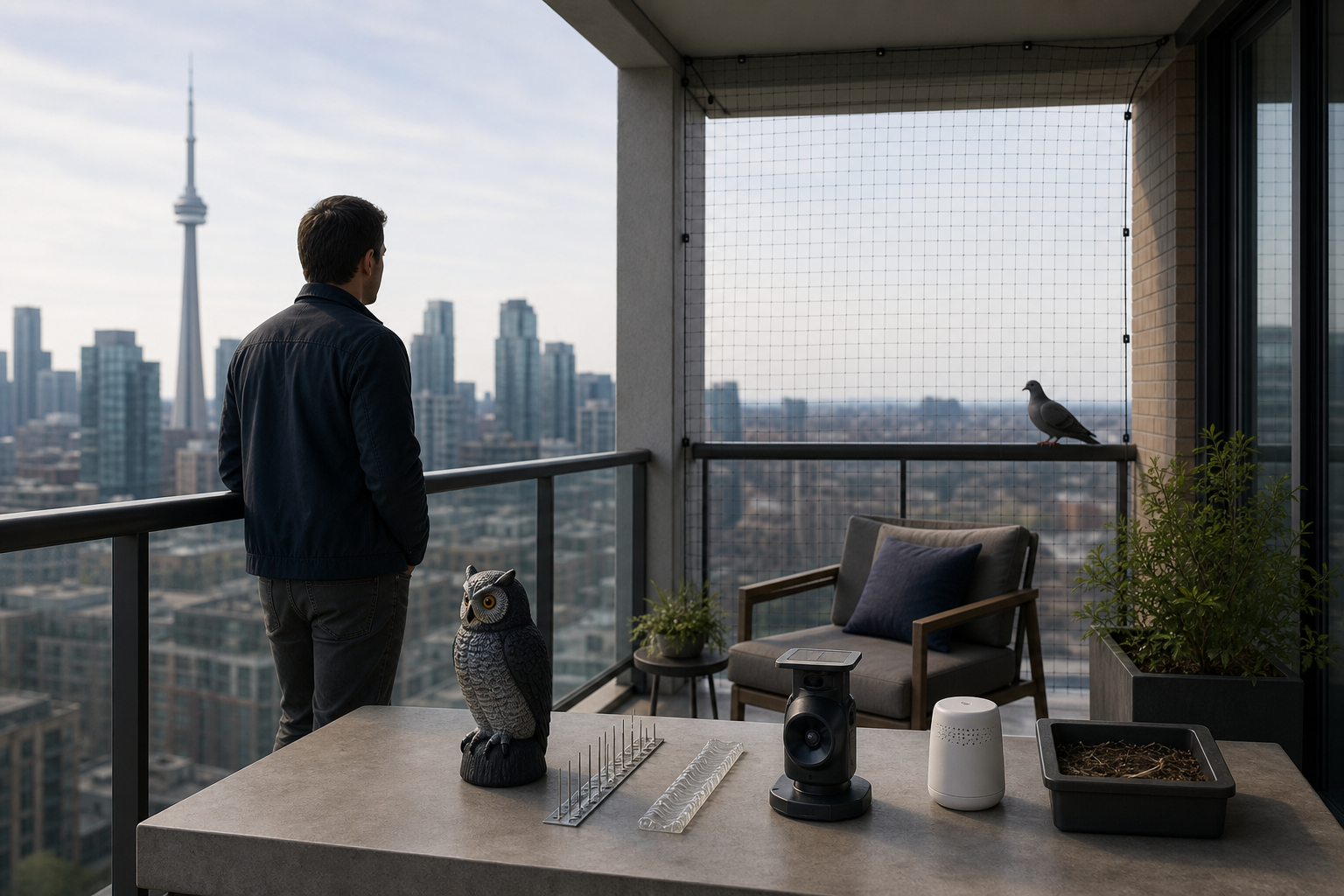

A unit on the 14th floor of a King West condo sold for $38,000 under asking last spring. The listing looked fine until the viewing. The balcony was covered in droppings, the railing corners packed with nesting debris. The buyer's agent requested professional remediation before closing, and the seller ate a $1,200 cleaning bill plus the price concession.
Pigeons aren't pests in the usual sense. They're cliff-dwellers who found better cliffs. Toronto's recessed balconies, HVAC nooks, and wind-sheltered east-facing units are evolutionary jackpots for birds programmed to nest on ledges. Once a pair raises a brood, they return to the exact spot. The question isn't whether you need a deterrent. It's which one works without creating a bigger problem.
The Gold Standard: Professional Netting
Heavy-duty polyethylene netting, professionally tensioned and anchored, is the only method that physically excludes pigeons from a balcony. Properly installed, it lasts 8-10 years and stops 100% of nesting attempts. The catch is fourfold. First, cost runs $500-$1,500 depending on balcony size and access complexity. Second, most Toronto condo boards classify netting as an "alteration to a common element" under Section 98 of the Ontario Condo Act. You need written approval, and many boards say no outright for aesthetic reasons. Third, cheap DIY netting, the thin mesh sold at hardware stores, entangles songbirds and creates a disposal problem. Fourth, even professional netting changes how your balcony looks and feels. You're living behind a screen.
Effectiveness: 10/10. Ethics: 8/10 if installed by pros who use the correct gauge and tensioning to prevent entanglement. Condo approval: 3/10.
Spikes: High Effort, Narrow Impact
Stainless steel or polycarbonate spikes prevent landing on railings. That's it. Pigeons will still nest in corners, under furniture, or on the floor itself. Installation requires drilling into common elements, which brings the same approval issue as netting. Spikes also fail if spacing is off, pigeons are surprisingly good at squeezing into gaps or perching on top of poorly installed strips. The real problem is that spikes solve the railing problem but not the nesting problem, and nesting is what drives the mess.
Effectiveness: 4/10. Ethics: 9/10 (humane if properly spaced). Condo approval: 2/10.
Optical Gel: The Reapplication Tax
Sticky translucent gel creates a multi-sensory deterrent. Pigeons see it as fire and avoid landing. It's less visually intrusive than netting and doesn't require drilling. The downside is maintenance. Gel degrades in UV and weather, losing effectiveness after 6-12 months. Reapplication costs add up. For a high-pressure balcony, you're looking at $200-$400 annually in product and labor. It works best as a supplemental layer on railings when the primary nesting sites are already blocked.
Effectiveness: 6/10. Ethics: 10/10. Condo approval: 8/10.
Motion-Activated Sprinklers and Ultrasonic Devices
Sprinklers startle pigeons but habituate them within days. Ultrasonic emitters are worse, pigeons hear in roughly the same range as humans, so the high-frequency noise does nothing except annoy your neighbors. Both categories are sold aggressively online. Both are near-useless in real-world balcony applications.
Effectiveness: 2/10. Ethics: 7/10 for sprinklers, 9/10 for ultrasonics (they just don't work). Condo approval: irrelevant.
The Plastic Owl: Peak Failure
Pigeons habituate to static decoys within 48 hours. Unless you're moving the owl daily and pairing it with other deterrents, it's decorative only. Pest control professionals view it as the least effective investment in the category. It persists because it's cheap and feels like you're doing something.
Effectiveness: 1/10. Ethics: 10/10 (harmless). Condo approval: 10/10 (nobody cares).
Where the Decision Flips
If your condo board allows netting and you're dealing with active nesting, pay for professional installation. If the board won't approve structural changes, layer optical gel on railings and remove all furniture or storage that creates sheltered corners. Clean weekly with a wet method (misting droppings before wiping prevents airborne spores). If you're tempted by the owl, don't.
The real move is proactive. Pigeons seek the leeward side of buildings during winter. East-facing balconies in Toronto see the highest pressure from November through March. Clear your balcony before the first nesting attempt. Once they've raised chicks, you're fighting biology.
Read Next
DLC Now Controls Both Filogix and Velocity: Why That Should Worry Every Independent Broker
MCAN's 19% earnings jump proves mortgage impairments aren't the risk signal investors think they are
Toronto Buyers Can Stop Writing Love Letters, The Market Already Did the Work
25 States Sue Trump Over Tariffs, Claiming Presidential Overreach on Import Taxes