Kelowna Now Ranks First in Canada for Wildfire Risk: What Condo Buyers Need to Know Before Closing
A national forecasting model just put Kelowna ahead of every other Canadian city for wildfire exposure in 2026. For anyone closing on a condo here in the next 90 days, that ranking isn't abstract, it's baked into your insurance quote, your strata corporation's fire mitigation budget, and the long-term resale value of the unit you're about to own.
The shift comes from Natural Resources Canada's updated Canadian Forest Fire Danger Rating System (CFFDRS), which now weights Kelowna's "wildland-urban interface" more heavily than previous models. That's the technical term for what happens when residential towers back directly onto forested hillsides. Kelowna has more of this interface per capita than almost any other city in the country. Upper Mission. Black Mountain. Wilden. University District. All of them place multi-family buildings within 30 meters of dry timber, which is the "Priority Zone" distance under FireSmart Canada's standards.
What Shows Up on the Title
Before you remove subjects, ask your lawyer to pull the full title. Some Kelowna properties carry registered Wildfire Hazard Easements or covenants under the BC Land Title Act. These aren't suggestions. They're legal obligations requiring you, or your strata corporation, to maintain specific vegetation standards on common property. Bark mulch gets replaced with rock. Ornamental cedars get removed. If the strata hasn't done the work, you inherit the liability the day you take possession.
A downtown concrete high-rise near the waterfront doesn't carry the same title restrictions as a wood-frame walkup in the hills. The risk is not uniform across postal codes. Pull the title early. If there's a covenant and the strata has ignored it, your insurer will know before you do.
The Real Insurance Conversation
Most BC condo policies cover fire damage. The issue isn't whether you can get coverage, it's what you'll pay and what the strata's master policy doesn't cover. Strata insurance premiums in high-risk Okanagan zones are climbing 1.5% to 3% annually, even for buildings with zero prior claims. That's the baseline before any loss events. If your building's master policy has a $50,000 deductible and a wildfire torches the landscaping, the strata assesses every owner for their proportionate share.
Ask your realtor for the strata's most recent Insurance Risk Assessment. If the building hasn't upgraded to tempered glass or replaced combustible siding, you're buying into a structure that will cost more to insure every year until those upgrades happen.
The Secondary Market Is Pricing This In
Newer condos built to 2020+ BC Building Code standards, non-combustible roofing, fire-rated siding, defensible spacing, are selling faster and holding value better than older timber-frame builds. The delta is roughly 10% to 15% on resale. Buyers are asking for proof of FireSmart certification during the offer stage. Properties that can document rock mulch installation, tempered glass, and recent strata fire-safety audits are closing above asking in some micro-climates.
The flip side: older wood-frame condos without mitigation are sitting longer. A unit in a 1980s building with cedar siding and bark mulch landscaping is harder to finance and harder to insure, which narrows your buyer pool when you eventually sell.
The Strata's Role Is Everything
Individual unit owners can't FireSmart common property. That's the strata corporation's job. If your prospective building hasn't updated its landscaping plan, hasn't budgeted for ember-resistant vents, or hasn't cleared the 30-meter Priority Zone, you're relying on a future council vote to protect your investment.
Read the last two years of AGM minutes. Look for mentions of FireSmart, wildfire mitigation, or insurance renewal challenges. If there's no discussion, that's a red flag. A strata that hasn't engaged with the risk is a strata that will be forced to assess owners reactively after the insurer non-renews or doubles the premium.
Kelowna's fire department is sophisticated. The city's Community Wildfire Resiliency Plan is among the most detailed in Western Canada. High risk does not automatically mean high damage. But it does mean you need to know what you're buying and whether the people managing the common property have done the work to earn the discount.


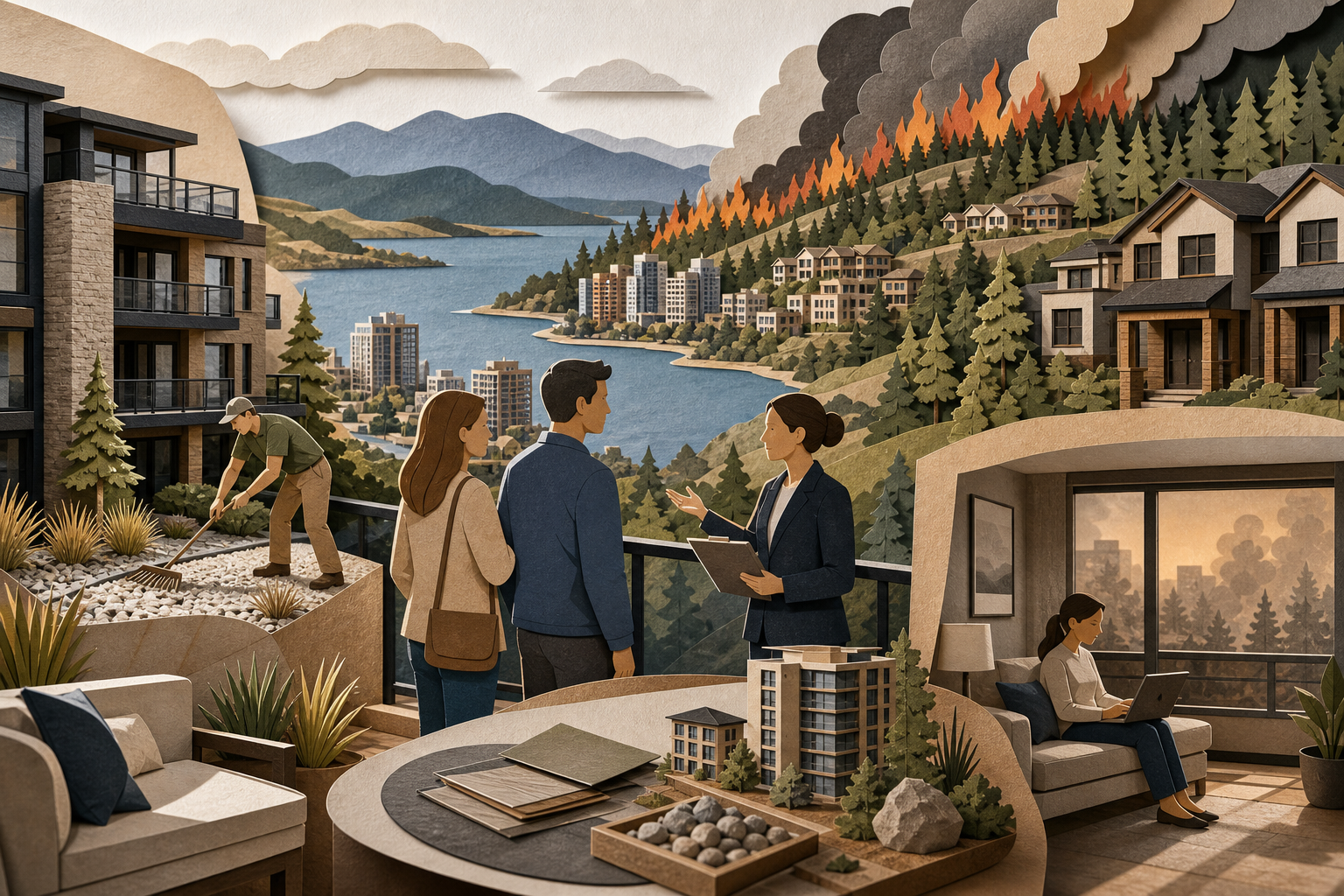

A national forecasting model just put Kelowna ahead of every other Canadian city for wildfire exposure in 2026. For anyone closing on a condo here in the next 90 days, that ranking isn't abstract, it's baked into your insurance quote, your strata corporation's fire mitigation budget, and the long-term resale value of the unit you're about to own.
The shift comes from Natural Resources Canada's updated Canadian Forest Fire Danger Rating System (CFFDRS), which now weights Kelowna's "wildland-urban interface" more heavily than previous models. That's the technical term for what happens when residential towers back directly onto forested hillsides. Kelowna has more of this interface per capita than almost any other city in the country. Upper Mission. Black Mountain. Wilden. University District. All of them place multi-family buildings within 30 meters of dry timber, which is the "Priority Zone" distance under FireSmart Canada's standards.
What Shows Up on the Title
Before you remove subjects, ask your lawyer to pull the full title. Some Kelowna properties carry registered Wildfire Hazard Easements or covenants under the BC Land Title Act. These aren't suggestions. They're legal obligations requiring you, or your strata corporation, to maintain specific vegetation standards on common property. Bark mulch gets replaced with rock. Ornamental cedars get removed. If the strata hasn't done the work, you inherit the liability the day you take possession.
A downtown concrete high-rise near the waterfront doesn't carry the same title restrictions as a wood-frame walkup in the hills. The risk is not uniform across postal codes. Pull the title early. If there's a covenant and the strata has ignored it, your insurer will know before you do.
The Real Insurance Conversation
Most BC condo policies cover fire damage. The issue isn't whether you can get coverage, it's what you'll pay and what the strata's master policy doesn't cover. Strata insurance premiums in high-risk Okanagan zones are climbing 1.5% to 3% annually, even for buildings with zero prior claims. That's the baseline before any loss events. If your building's master policy has a $50,000 deductible and a wildfire torches the landscaping, the strata assesses every owner for their proportionate share.
Ask your realtor for the strata's most recent Insurance Risk Assessment. If the building hasn't upgraded to tempered glass or replaced combustible siding, you're buying into a structure that will cost more to insure every year until those upgrades happen.
The Secondary Market Is Pricing This In
Newer condos built to 2020+ BC Building Code standards, non-combustible roofing, fire-rated siding, defensible spacing, are selling faster and holding value better than older timber-frame builds. The delta is roughly 10% to 15% on resale. Buyers are asking for proof of FireSmart certification during the offer stage. Properties that can document rock mulch installation, tempered glass, and recent strata fire-safety audits are closing above asking in some micro-climates.
The flip side: older wood-frame condos without mitigation are sitting longer. A unit in a 1980s building with cedar siding and bark mulch landscaping is harder to finance and harder to insure, which narrows your buyer pool when you eventually sell.
The Strata's Role Is Everything
Individual unit owners can't FireSmart common property. That's the strata corporation's job. If your prospective building hasn't updated its landscaping plan, hasn't budgeted for ember-resistant vents, or hasn't cleared the 30-meter Priority Zone, you're relying on a future council vote to protect your investment.
Read the last two years of AGM minutes. Look for mentions of FireSmart, wildfire mitigation, or insurance renewal challenges. If there's no discussion, that's a red flag. A strata that hasn't engaged with the risk is a strata that will be forced to assess owners reactively after the insurer non-renews or doubles the premium.
Kelowna's fire department is sophisticated. The city's Community Wildfire Resiliency Plan is among the most detailed in Western Canada. High risk does not automatically mean high damage. But it does mean you need to know what you're buying and whether the people managing the common property have done the work to earn the discount.
Read Next
MCAN's 19% earnings jump proves mortgage impairments aren't the risk signal investors think they are
Toronto Buyers Can Stop Writing Love Letters, The Market Already Did the Work
25 States Sue Trump Over Tariffs, Claiming Presidential Overreach on Import Taxes
Carney's Alberta housing pitch meets canola fields and separatist flags