How Ontario First-Time Buyers Can Stack FHSA and RRSP Withdrawals for a $100,000 Tax-Free Down Payment
You can pull $100,000 from registered accounts to buy your first home without paying tax on any of it. Most people don't know that. Seventy percent of first-time buyers, according to mortgage brokers working Ontario files in early 2026, think they have to choose between the First Home Savings Account and the RRSP Home Buyers' Plan. They don't. You stack them.
Here's the math. The FHSA lets you shelter $8,000 a year up to a $40,000 lifetime cap. Every dollar you contribute is deductible. Every dollar you withdraw for a qualifying home purchase comes out tax-free with no repayment obligation. The RRSP Home Buyers' Plan, raised to a $60,000 limit in 2025, lets you borrow from your own retirement savings to fund a down payment, also tax-free, as long as you pay it back over fifteen years. Put them together and you've got $100,000. A couple? $200 A 29-year-old dental hygienist in Mississauga making $72,000 a year wants to buy a condo. She's saved $23,000 in her RRSP over five years. Her boyfriend, a teacher making $68,000, has $18,000 in his RRSP. Together they've got $41,000. They need at least $120,000 to hit 20% down on a $600,000 property and avoid mortgage insurance. They think they're two years away from buying. They're not. They can close in twelve months.
Max Out the FHSA First, RRSP Second
Open an FHSA at any major Canadian bank or discount brokerage in January 2026. Contribute $8,000 by December. The contribution drops your taxable income dollar-for-dollar. A $72,000 earner in Ontario pays roughly 29.65% marginal tax, so that $8,000 contribution generates a $2,372 refund. File your return in March 2027, get the refund, and immediately contribute another $8,000 to the FHSA for 2027. You now have $16,000 in the account, plus $2,372 in your pocket for closing costs or Land Transfer Tax.
The FHSA allows $8,000 per year up to a $40,000 lifetime cap. It takes five calendar years to max out if you hit the limit every January. You cannot backfill unused room the way you can with an RRSP. Miss a year and you lose that $8,000 slot permanently. If you're planning to buy in 2028 or later, open the account now even if you can't contribute the full amount immediately.
Park FHSA funds in a high-interest savings account or short-term GIC, not equities. The money needs to be liquid when you're ready to withdraw. A 5% HISA on $40,000 generates $2,000 in tax-free growth inside the account. That growth also comes out tax-free when you buy. The RRSP Home Buyers' Plan does not tax your gains either, but you have to pay back the principal. The FHSA requires no repayment.
Use the RRSP to Fill the Gap
Once you've maxed the FHSA or gotten close, move to the RRSP. The Home Buyers' Plan lets you withdraw up to $60,000 from your RRSP for a down payment as long as you repay it over fifteen years. That repayment starts two years after you withdraw, so if you pull the money in April 2027, your first repayment isn't due until 2029. The annual repayment is one-fifteenth of what you withdrew, $4,000 per year if you took the full $60,000.
RRSP contributions must sit in the account for at least 90 days before you can withdraw them under the HBP. Contribute in January, withdraw in May. Contribute in September, don't touch it until December. If you pull funds before the 90-day window closes, the contribution isn't tax-deductible and you've just created a taxable withdrawal. The FHSA does not have this 90-day rule.
The couple above, $72K and $68K, can each max an FHSA at $40,000 and pull $60,000 from their RRSPs. That's $200,000 combined, all withdrawn tax-free. Even if they haven't maxed their FHSA yet, $16,000 per person in the FHSA plus $50,000 each from their existing RRSPs still gets them to $132,000. That clears the 20% threshold on a $600,000 property and covers Ontario's Land Transfer Tax of roughly $8,500.
The Repayment Trap Most People Miss
The HBP is a loan from your future self. If you withdraw $60,000, you owe yourself $4,000 a year starting two years later. Miss a payment and that $4,000 gets added to your taxable income. For someone in a 29.65% bracket, that's $1,186 in tax on money you didn't receive. Do that three years in a row and you've paid $3,558 in penalties for failing to repay a loan that had no interest.
The federal government extended the grace period to five years for buyers who withdrew between early 2022 and late 2025, but that measure is temporary and tied to pandemic-era relief. Verify your specific repayment start date with CRA when you file form T1036. If you're not confident you can repay $4,000 annually starting in year three, take less from the RRSP and lean harder on the FHSA, which has no repayment requirement.
Who Qualifies
You're a first-time buyer if you haven't owned a principal residence in the year of purchase or the four preceding calendar years. A couple where one partner owned a condo in 2021 does not qualify in 2026 unless the non-owner applies alone, in which case only their FHSA and RRSP are accessible. Separated or divorced buyers often requalify under this rule if enough time has passed.
The property must be in Canada. It must become your principal residence within one year of purchase. You must be a Canadian resident. Those three conditions apply to both accounts. Breaking any one disqualifies the withdrawal and triggers full taxation.


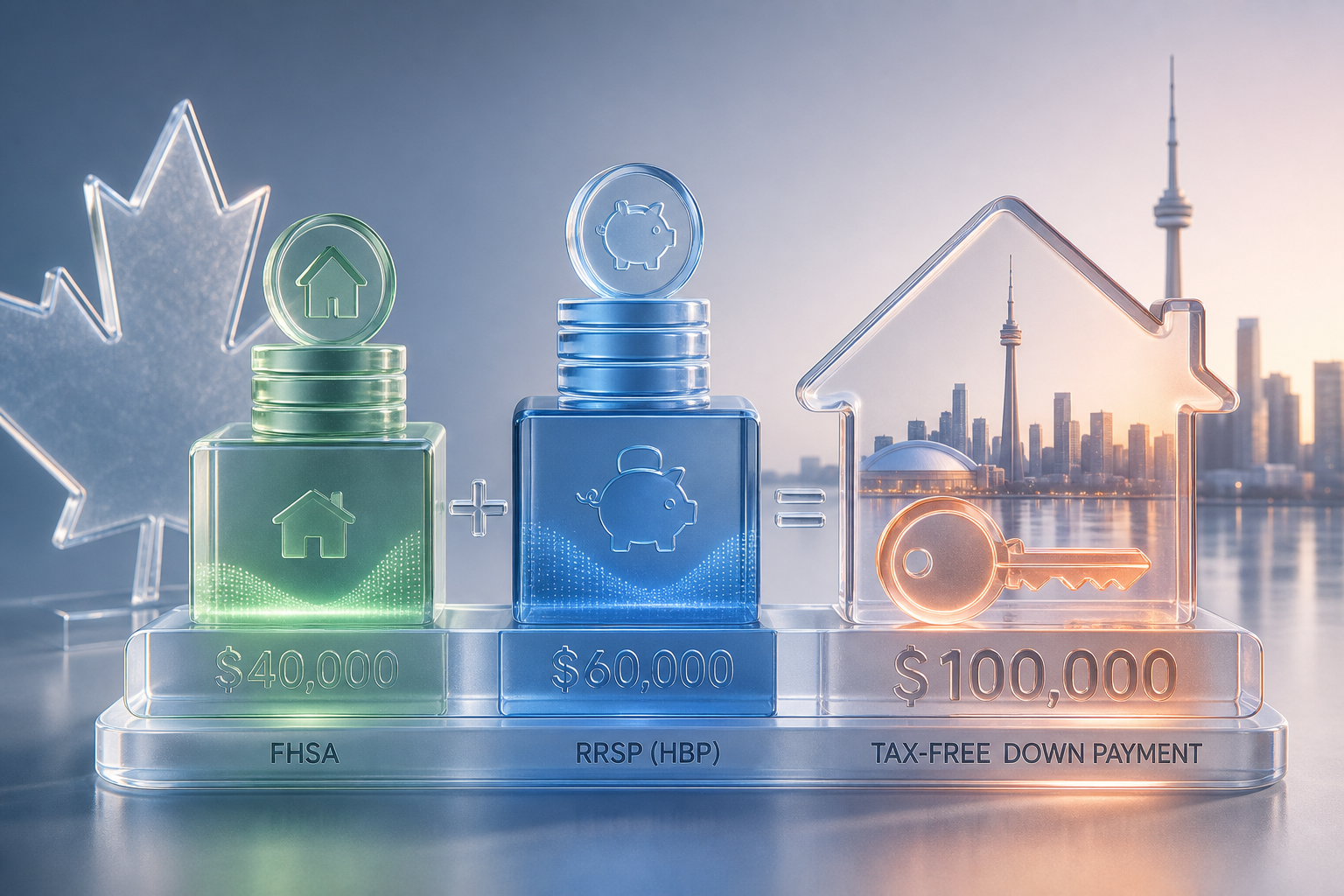

You can pull $100,000 from registered accounts to buy your first home without paying tax on any of it. Most people don't know that. Seventy percent of first-time buyers, according to mortgage brokers working Ontario files in early 2026, think they have to choose between the First Home Savings Account and the RRSP Home Buyers' Plan. They don't. You stack them.
Here's the math. The FHSA lets you shelter $8,000 a year up to a $40,000 lifetime cap. Every dollar you contribute is deductible. Every dollar you withdraw for a qualifying home purchase comes out tax-free with no repayment obligation. The RRSP Home Buyers' Plan, raised to a $60,000 limit in 2025, lets you borrow from your own retirement savings to fund a down payment, also tax-free, as long as you pay it back over fifteen years. Put them together and you've got $100,000. A couple? $200 A 29-year-old dental hygienist in Mississauga making $72,000 a year wants to buy a condo. She's saved $23,000 in her RRSP over five years. Her boyfriend, a teacher making $68,000, has $18,000 in his RRSP. Together they've got $41,000. They need at least $120,000 to hit 20% down on a $600,000 property and avoid mortgage insurance. They think they're two years away from buying. They're not. They can close in twelve months.
Max Out the FHSA First, RRSP Second
Open an FHSA at any major Canadian bank or discount brokerage in January 2026. Contribute $8,000 by December. The contribution drops your taxable income dollar-for-dollar. A $72,000 earner in Ontario pays roughly 29.65% marginal tax, so that $8,000 contribution generates a $2,372 refund. File your return in March 2027, get the refund, and immediately contribute another $8,000 to the FHSA for 2027. You now have $16,000 in the account, plus $2,372 in your pocket for closing costs or Land Transfer Tax.
The FHSA allows $8,000 per year up to a $40,000 lifetime cap. It takes five calendar years to max out if you hit the limit every January. You cannot backfill unused room the way you can with an RRSP. Miss a year and you lose that $8,000 slot permanently. If you're planning to buy in 2028 or later, open the account now even if you can't contribute the full amount immediately.
Park FHSA funds in a high-interest savings account or short-term GIC, not equities. The money needs to be liquid when you're ready to withdraw. A 5% HISA on $40,000 generates $2,000 in tax-free growth inside the account. That growth also comes out tax-free when you buy. The RRSP Home Buyers' Plan does not tax your gains either, but you have to pay back the principal. The FHSA requires no repayment.
Use the RRSP to Fill the Gap
Once you've maxed the FHSA or gotten close, move to the RRSP. The Home Buyers' Plan lets you withdraw up to $60,000 from your RRSP for a down payment as long as you repay it over fifteen years. That repayment starts two years after you withdraw, so if you pull the money in April 2027, your first repayment isn't due until 2029. The annual repayment is one-fifteenth of what you withdrew, $4,000 per year if you took the full $60,000.
RRSP contributions must sit in the account for at least 90 days before you can withdraw them under the HBP. Contribute in January, withdraw in May. Contribute in September, don't touch it until December. If you pull funds before the 90-day window closes, the contribution isn't tax-deductible and you've just created a taxable withdrawal. The FHSA does not have this 90-day rule.
The couple above, $72K and $68K, can each max an FHSA at $40,000 and pull $60,000 from their RRSPs. That's $200,000 combined, all withdrawn tax-free. Even if they haven't maxed their FHSA yet, $16,000 per person in the FHSA plus $50,000 each from their existing RRSPs still gets them to $132,000. That clears the 20% threshold on a $600,000 property and covers Ontario's Land Transfer Tax of roughly $8,500.
The Repayment Trap Most People Miss
The HBP is a loan from your future self. If you withdraw $60,000, you owe yourself $4,000 a year starting two years later. Miss a payment and that $4,000 gets added to your taxable income. For someone in a 29.65% bracket, that's $1,186 in tax on money you didn't receive. Do that three years in a row and you've paid $3,558 in penalties for failing to repay a loan that had no interest.
The federal government extended the grace period to five years for buyers who withdrew between early 2022 and late 2025, but that measure is temporary and tied to pandemic-era relief. Verify your specific repayment start date with CRA when you file form T1036. If you're not confident you can repay $4,000 annually starting in year three, take less from the RRSP and lean harder on the FHSA, which has no repayment requirement.
Who Qualifies
You're a first-time buyer if you haven't owned a principal residence in the year of purchase or the four preceding calendar years. A couple where one partner owned a condo in 2021 does not qualify in 2026 unless the non-owner applies alone, in which case only their FHSA and RRSP are accessible. Separated or divorced buyers often requalify under this rule if enough time has passed.
The property must be in Canada. It must become your principal residence within one year of purchase. You must be a Canadian resident. Those three conditions apply to both accounts. Breaking any one disqualifies the withdrawal and triggers full taxation.
Read Next
DLC Now Controls Both Filogix and Velocity: Why That Should Worry Every Independent Broker
MCAN's 19% earnings jump proves mortgage impairments aren't the risk signal investors think they are
Toronto Buyers Can Stop Writing Love Letters, The Market Already Did the Work
25 States Sue Trump Over Tariffs, Claiming Presidential Overreach on Import Taxes