CMHC Now Sees Home Price Declines Through 2026, Not Recovery
Housing starts are down. Sales are down. And now, for the first time in years, the agency tasked with tracking all of it has stopped pretending prices will stabilize soon.
Canada Mortgage and Housing Corporation revised its 2026 outlook last week, forecasting simultaneous declines in home sales, average prices, and new construction starts. The shift matters because CMHC doesn't make these calls lightly. Its models pull from sales velocity, financing conditions, inventory absorption, and population flows. When all three metrics, sales, prices, starts, point down at once, the agency is signaling something deeper than a seasonal dip.
The triple constraint squeezing demand
Three forces are converging. First, the Bank of Canada's policy rate remains in the mid-4% range, which keeps the mortgage stress test brutal. A buyer qualifying at today's rates can borrow roughly 30% less than the same buyer could have in early 2022, when variable rates were sub-2%. The math is non-negotiable.
Second, population growth is moderating. Federal caps on non-permanent residents and international student visas, implemented in 2024, are finally showing up in the data. Net inflows that previously added 400,000+ people annually are now tracking closer to 250,000. For a decade, population growth acted as an absolute floor under housing demand. That floor is cracking.
Third, buyers have adopted a wait-and-see posture. Falling prices create their own gravity. Even households that can afford to buy are holding back, fearing they'll catch a falling knife. The sales-to-new-listings ratio in parts of Ontario and British Columbia has dropped below 40%, firmly into buyer's market territory, yet transaction volumes continue to fall. That tells you the issue isn't just affordability. It's belief.
The developer trap
The irony of 2026 is this: Canada desperately needs more housing units, yet the economic environment is punishing the people who build them. High construction costs, labor shortages, material inflation, combined with high financing rates have made many purpose-built rental projects unviable. CMHC projects national starts will fall below 220,000 units this year, down from the 2024-2025 average.
This creates a supply lag that may bite hard in three to five years. If the Bank of Canada cuts rates aggressively in late 2026 or 2027, the pent-up demand sitting on the sidelines could flood back into a market with fewer completed units than it needed. Prices that fall today may spike tomorrow, not because fundamentals improved, but because supply never caught up.
What stays stubborn
Falling home prices don't mean falling rents. The two markets decouple regularly. Would-be buyers who stay renters keep rental demand elevated, which in turn keeps institutional investors interested in the asset class. A 47-year-old engineer in Mississauga who can't stomach a $1.2 million detached home at 5.5% still needs a place to live. That rent check doesn't disappear.
Regional divergence also remains. While the national average trends down, markets in Alberta and Saskatchewan, where prices never spiked as violently and inventory stayed looser, may see minimal depreciation. The Greater Toronto Area and Lower Mainland, by contrast, are absorbing the bulk of the correction. Broad forecasts mask local realities.
The psychological shift is harder to quantify but likely more durable. For a decade, the consensus was that Canadian real estate only goes up. CMHC's current bearishness signals the end of that reflexive assumption. When the most authoritative voice in the market stops promising recovery, buyers internalize it. Momentum works both ways.


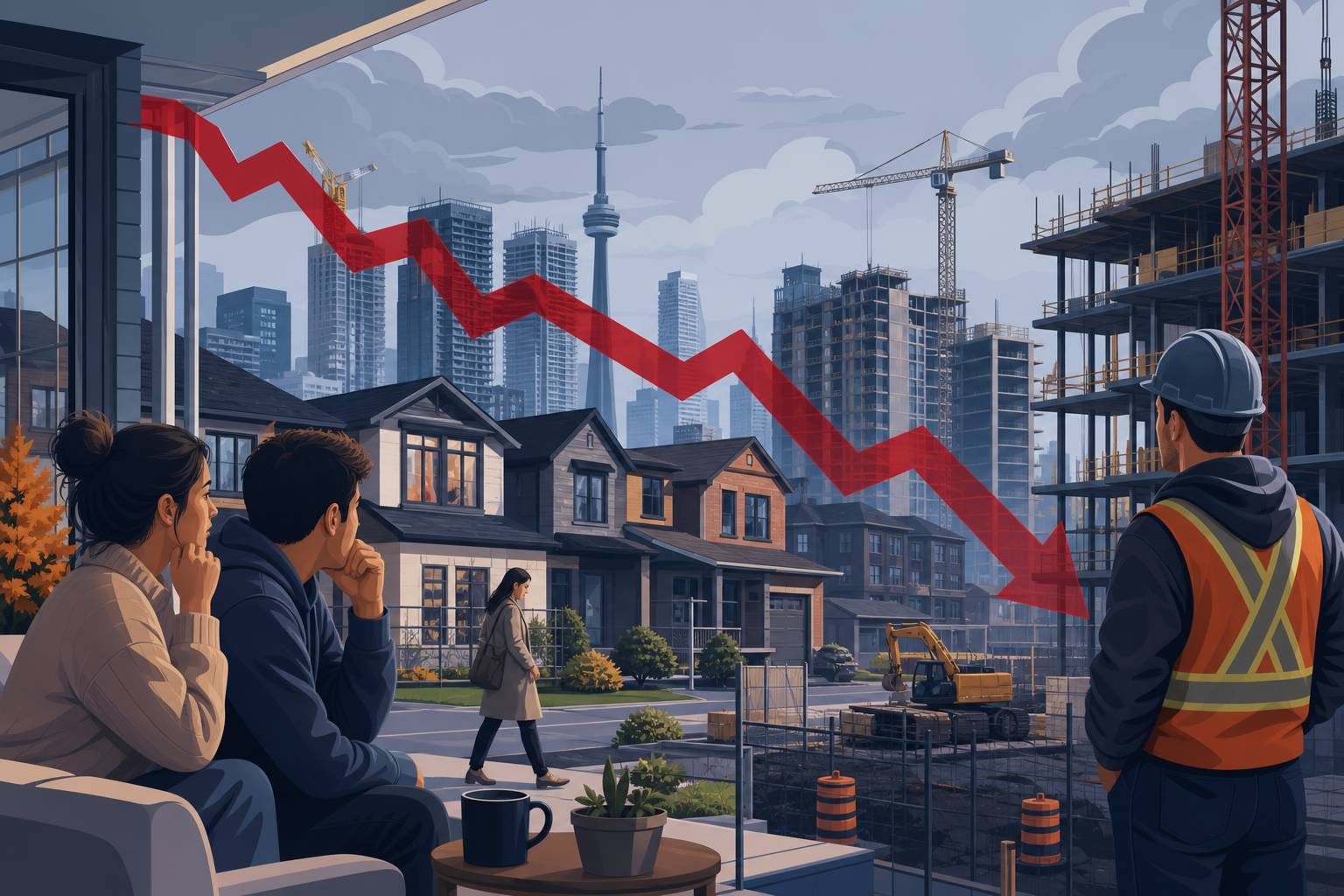

Housing starts are down. Sales are down. And now, for the first time in years, the agency tasked with tracking all of it has stopped pretending prices will stabilize soon.
Canada Mortgage and Housing Corporation revised its 2026 outlook last week, forecasting simultaneous declines in home sales, average prices, and new construction starts. The shift matters because CMHC doesn't make these calls lightly. Its models pull from sales velocity, financing conditions, inventory absorption, and population flows. When all three metrics, sales, prices, starts, point down at once, the agency is signaling something deeper than a seasonal dip.
The triple constraint squeezing demand
Three forces are converging. First, the Bank of Canada's policy rate remains in the mid-4% range, which keeps the mortgage stress test brutal. A buyer qualifying at today's rates can borrow roughly 30% less than the same buyer could have in early 2022, when variable rates were sub-2%. The math is non-negotiable.
Second, population growth is moderating. Federal caps on non-permanent residents and international student visas, implemented in 2024, are finally showing up in the data. Net inflows that previously added 400,000+ people annually are now tracking closer to 250,000. For a decade, population growth acted as an absolute floor under housing demand. That floor is cracking.
Third, buyers have adopted a wait-and-see posture. Falling prices create their own gravity. Even households that can afford to buy are holding back, fearing they'll catch a falling knife. The sales-to-new-listings ratio in parts of Ontario and British Columbia has dropped below 40%, firmly into buyer's market territory, yet transaction volumes continue to fall. That tells you the issue isn't just affordability. It's belief.
The developer trap
The irony of 2026 is this: Canada desperately needs more housing units, yet the economic environment is punishing the people who build them. High construction costs, labor shortages, material inflation, combined with high financing rates have made many purpose-built rental projects unviable. CMHC projects national starts will fall below 220,000 units this year, down from the 2024-2025 average.
This creates a supply lag that may bite hard in three to five years. If the Bank of Canada cuts rates aggressively in late 2026 or 2027, the pent-up demand sitting on the sidelines could flood back into a market with fewer completed units than it needed. Prices that fall today may spike tomorrow, not because fundamentals improved, but because supply never caught up.
What stays stubborn
Falling home prices don't mean falling rents. The two markets decouple regularly. Would-be buyers who stay renters keep rental demand elevated, which in turn keeps institutional investors interested in the asset class. A 47-year-old engineer in Mississauga who can't stomach a $1.2 million detached home at 5.5% still needs a place to live. That rent check doesn't disappear.
Regional divergence also remains. While the national average trends down, markets in Alberta and Saskatchewan, where prices never spiked as violently and inventory stayed looser, may see minimal depreciation. The Greater Toronto Area and Lower Mainland, by contrast, are absorbing the bulk of the correction. Broad forecasts mask local realities.
The psychological shift is harder to quantify but likely more durable. For a decade, the consensus was that Canadian real estate only goes up. CMHC's current bearishness signals the end of that reflexive assumption. When the most authoritative voice in the market stops promising recovery, buyers internalize it. Momentum works both ways.
Read Next
MCAN's 19% earnings jump proves mortgage impairments aren't the risk signal investors think they are
Toronto Buyers Can Stop Writing Love Letters, The Market Already Did the Work
25 States Sue Trump Over Tariffs, Claiming Presidential Overreach on Import Taxes
Carney's Alberta housing pitch meets canola fields and separatist flags