CMHC Blames Trade Wars and Population for Housing Slowdown. It's Ignoring the Real Problem.
The federal housing agency just released a forecast showing new housing starts will decline through 2028, and the explanation reads like a weather report: tariffs, unsold condos, population targets. All true. None of them the root problem.
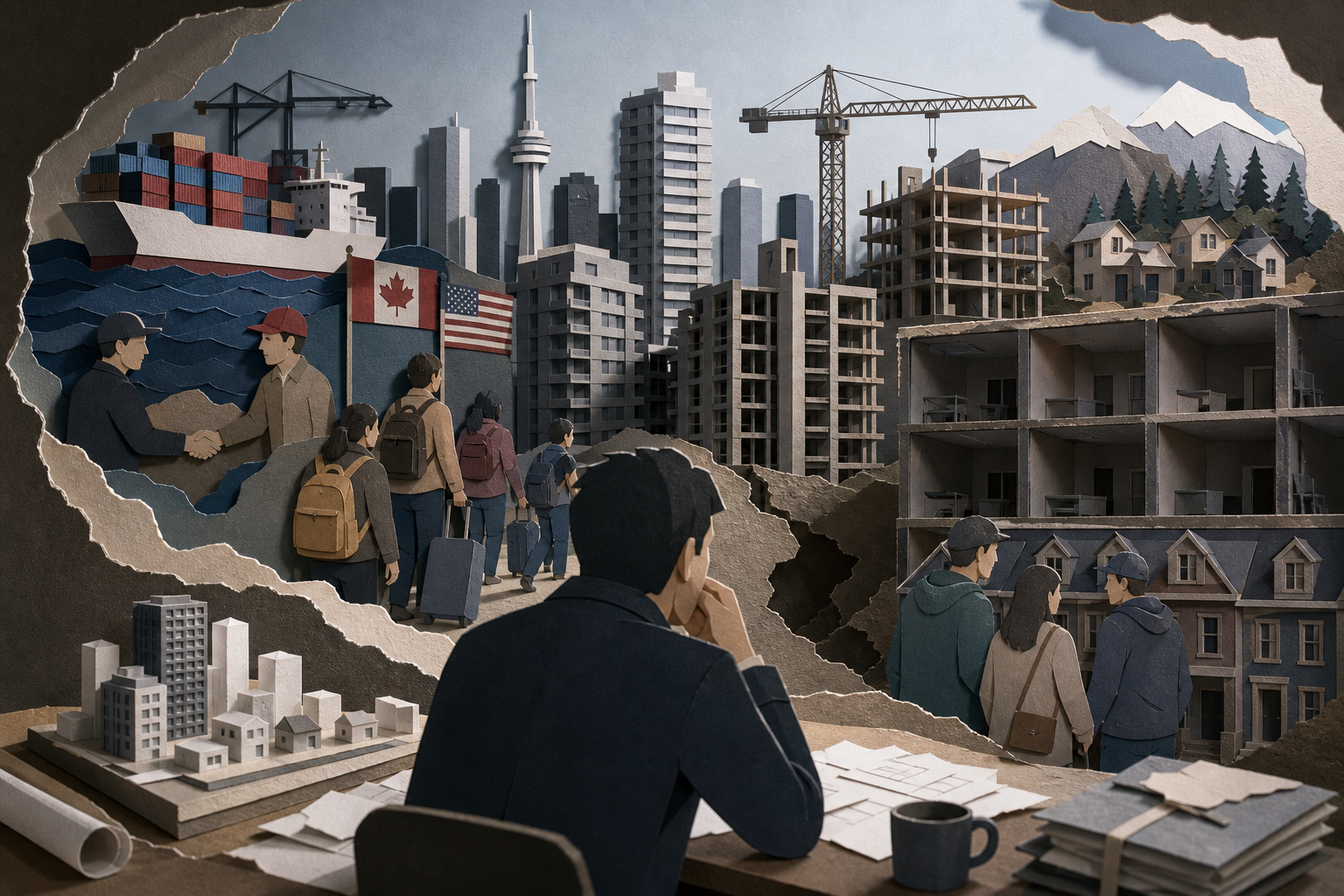
CMHC's analysis names the proximate causes correctly. There's a glut of finished, unsold condos sitting empty in Toronto and Vancouver. Trade friction with the U.S. has pushed the cost of imported steel and specialized materials up 15-20% since 2022. The federal government capped international student permits and tightened temporary resident levels, aiming to bring that cohort down to 5% of the population by the end of 2026, which softens immediate rental demand. These are real pressures, and they're measurably slowing construction.
But framing the slowdown as a function of these variables misses what's structurally broken. The housing market isn't slowing because external shocks are hitting it. It's slowing because the financing model that drove the last decade of building, cheap debt funding speculative high-rise towers sold pre-construction to individual investors, only works at sub-2% interest rates. The Bank of Canada's policy rate has stabilized in the mid-3% range. That's not high by historical standards. It's just high enough that the old playbook doesn't pencil.
Developers aren't pausing projects because of tariffs. They're pausing because the buyers who used to line up for pre-sales, the investor class treating condos as leveraged savings accounts, can no longer justify the math when mortgage rates sit above 5% and rental yields in Toronto barely clear 3%. The tariff story is convenient because it frames the problem as external and temporary. The debt story is inconvenient because it implies the boom period was an artifact of monetary policy, not sustainable demand.
The Inventory That Nobody Wants
The condo surplus CMHC flags is itself a symptom. Builders didn't suddenly over-produce units by accident. They built to a specific buyer profile: the investor purchaser who would close on a unit, rent it out, and bank on appreciation. That buyer has disappeared. Not because they moved to another city, but because the carry cost now exceeds the rental income. A 600-square-foot one-bedroom in Liberty Village that rents for $2,400 a month costs the owner roughly $3,200 to carry at current rates, before maintenance fees. The unsold inventory isn't a supply problem. It's a financing problem dressed up as oversupply.
The trade war angle does real damage, material costs are legitimately up, but it's a second-order effect. A 15% cost increase on inputs matters when your margin is thin. It doesn't matter when you can't finance the project in the first place or can't find buyers willing to absorb the freight. The tariffs are the tax. The interest rate regime is the structural barrier.
What Slowing Population Growth Actually Reveals
The population slowdown, meanwhile, is policy-induced and arguably necessary after years of immigration levels outpacing infrastructure investment. But using it to explain declining housing starts inverts the causality. We didn't build enough housing when population growth was at record highs. Now we're building even less as growth moderates. That's not a story about demand matching supply. That's a story about a construction sector that was never responsive to population-driven need in the first place, only to the availability of speculative capital.
The long-term structural demand for housing in Canada hasn't softened. What's softened is the financial viability of the business model that drove supply. Until someone names that plainly, every forecast will treat the current slowdown as a temporary dip caused by bad luck on trade and immigration timing. It isn't. It's the market adjusting to the end of free money, and no amount of federal funding or tariff negotiation will restart the machine as long as the underlying return profile has flipped.
CMHC is documenting the decline accurately. It's just calling it weather when it's climate.



The federal housing agency just released a forecast showing new housing starts will decline through 2028, and the explanation reads like a weather report: tariffs, unsold condos, population targets. All true. None of them the root problem.
CMHC's analysis names the proximate causes correctly. There's a glut of finished, unsold condos sitting empty in Toronto and Vancouver. Trade friction with the U.S. has pushed the cost of imported steel and specialized materials up 15-20% since 2022. The federal government capped international student permits and tightened temporary resident levels, aiming to bring that cohort down to 5% of the population by the end of 2026, which softens immediate rental demand. These are real pressures, and they're measurably slowing construction.
But framing the slowdown as a function of these variables misses what's structurally broken. The housing market isn't slowing because external shocks are hitting it. It's slowing because the financing model that drove the last decade of building, cheap debt funding speculative high-rise towers sold pre-construction to individual investors, only works at sub-2% interest rates. The Bank of Canada's policy rate has stabilized in the mid-3% range. That's not high by historical standards. It's just high enough that the old playbook doesn't pencil.
Developers aren't pausing projects because of tariffs. They're pausing because the buyers who used to line up for pre-sales, the investor class treating condos as leveraged savings accounts, can no longer justify the math when mortgage rates sit above 5% and rental yields in Toronto barely clear 3%. The tariff story is convenient because it frames the problem as external and temporary. The debt story is inconvenient because it implies the boom period was an artifact of monetary policy, not sustainable demand.
The Inventory That Nobody Wants
The condo surplus CMHC flags is itself a symptom. Builders didn't suddenly over-produce units by accident. They built to a specific buyer profile: the investor purchaser who would close on a unit, rent it out, and bank on appreciation. That buyer has disappeared. Not because they moved to another city, but because the carry cost now exceeds the rental income. A 600-square-foot one-bedroom in Liberty Village that rents for $2,400 a month costs the owner roughly $3,200 to carry at current rates, before maintenance fees. The unsold inventory isn't a supply problem. It's a financing problem dressed up as oversupply.
The trade war angle does real damage, material costs are legitimately up, but it's a second-order effect. A 15% cost increase on inputs matters when your margin is thin. It doesn't matter when you can't finance the project in the first place or can't find buyers willing to absorb the freight. The tariffs are the tax. The interest rate regime is the structural barrier.
What Slowing Population Growth Actually Reveals
The population slowdown, meanwhile, is policy-induced and arguably necessary after years of immigration levels outpacing infrastructure investment. But using it to explain declining housing starts inverts the causality. We didn't build enough housing when population growth was at record highs. Now we're building even less as growth moderates. That's not a story about demand matching supply. That's a story about a construction sector that was never responsive to population-driven need in the first place, only to the availability of speculative capital.
The long-term structural demand for housing in Canada hasn't softened. What's softened is the financial viability of the business model that drove supply. Until someone names that plainly, every forecast will treat the current slowdown as a temporary dip caused by bad luck on trade and immigration timing. It isn't. It's the market adjusting to the end of free money, and no amount of federal funding or tariff negotiation will restart the machine as long as the underlying return profile has flipped.
CMHC is documenting the decline accurately. It's just calling it weather when it's climate.
Read Next
MCAN's 19% earnings jump proves mortgage impairments aren't the risk signal investors think they are
Toronto Buyers Can Stop Writing Love Letters, The Market Already Did the Work
25 States Sue Trump Over Tariffs, Claiming Presidential Overreach on Import Taxes
Carney's Alberta housing pitch meets canola fields and separatist flags