BMO Says Bank of Canada Rate Hold Won't Survive Trump Tariffs
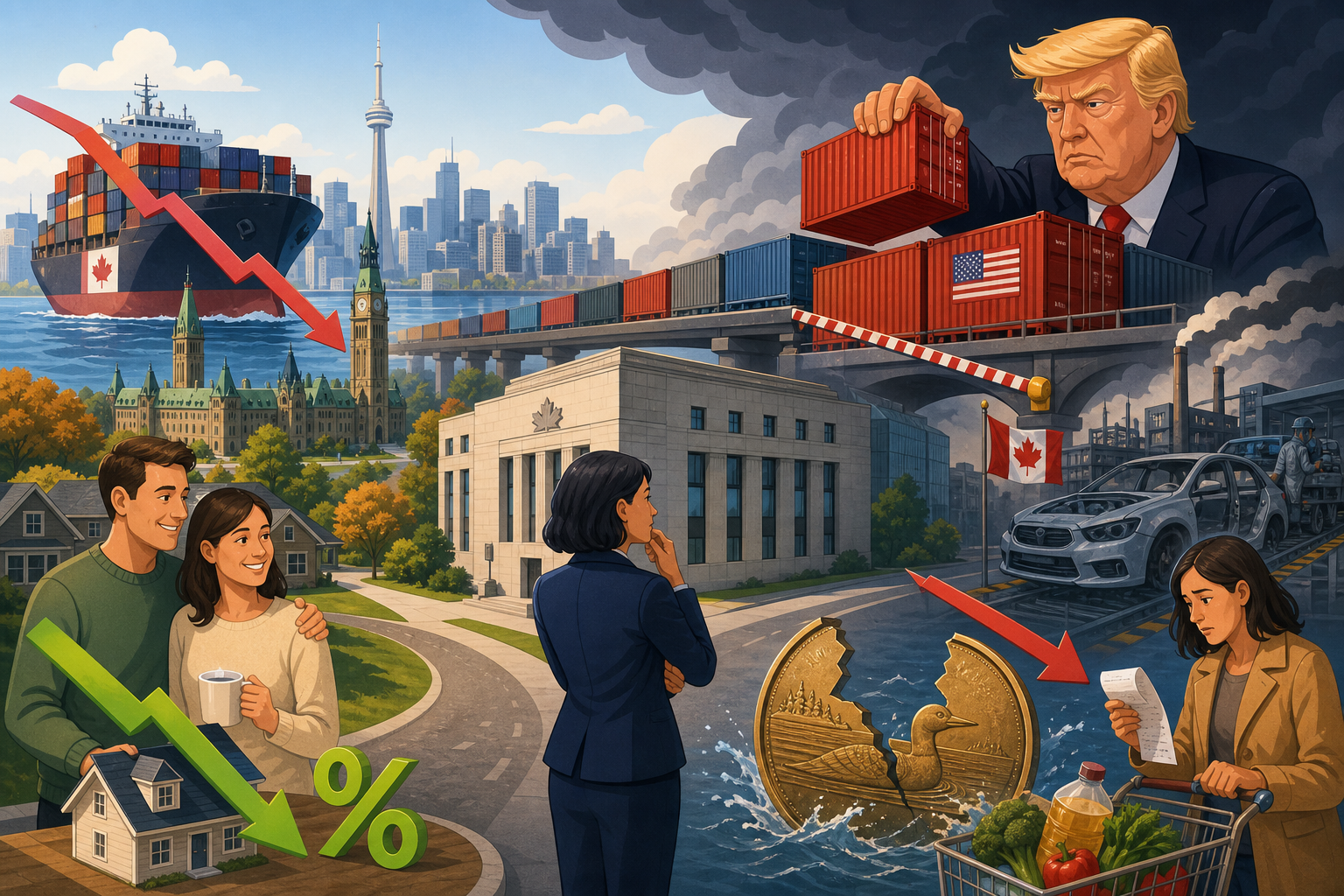
Canada ships three-quarters of its exports south. That dependence means any serious U.S. tariff push, universal 10% baseline or sector-specific, stops being a political headline and starts showing up as a drag on GDP within a quarter.
BMO Capital Markets sees this clearly. The Bank of Canada's current posture, which assumes a policy hold through mid-2026, depends on trade staying roughly where it is. If the Trump administration follows through with aggressive tariff threats during the USMCA review, that assumption breaks. The BoC would face a choice: defend against imported inflation from higher tariff costs, or cushion the economy against the recession those tariffs cause. History suggests they pick the latter.
The Arithmetic Overrides the Politics
Tariffs are inflationary by design. They raise prices on goods crossing the border. But the BoC doesn't treat policy-induced price spikes the way it treats demand-driven inflation. When a tariff wall goes up, the immediate effect is a collapse in trade volume, not runaway consumption. Canadian manufacturers lose orders. Exporters freeze capital spending. The loonie weakens, which imports more inflation but also makes Canadian goods cheaper on global markets, a buffer, not a solution.
The net result is stagflationary pressure. Growth stalls while some prices rise. In that scenario, the Bank typically prioritizes growth. Raising rates into a trade-induced slowdown amplifies the damage. Cutting rates won't stop the tariffs, but it can offset some of the domestic contraction. That's the playbook from 2018-2019, when the first round of steel and aluminum tariffs hit.
The USMCA Review Is Not a Distant Threat
The scheduled 2026 review of the United States-Mexico-Canada Agreement is already shaping investment decisions. Businesses don't wait for tariffs to be implemented before they adjust. The threat alone causes paralysis. Projects get deferred. Hiring slows. By the time tariffs actually land, the economic damage has a running start.
If the U.S. administration uses the review window to impose sweeping duties, whether on autos, softwood lumber, or a universal baseline, the BoC's current rate-hold forecast collapses. A 10% universal tariff on Canadian goods would be the equivalent of a tax on 75% of our export economy. The Federal Reserve might shrug that off. The Bank of Canada cannot.
Retaliation Makes the Problem Worse
Canada's default response to U.S. tariffs has been reciprocal action. We did it in 2018 with steel and aluminum. We'll likely do it again. But retaliation complicates the BoC's job. Imposing tariffs on U.S. goods raises domestic prices for Canadian consumers and businesses. That injects inflation into the system at the exact moment the economy is slowing. It forces the Bank to choose between fighting inflation and supporting growth, never a clean trade.
The paradox: bad news on trade becomes bullish news for mortgage holders. A trade war accelerates the timeline for rate cuts, even if the underlying cause is economic damage. The BoC would be cutting from weakness, not strength.
Sticky Inflation Remains the Wild Card
If Canadian inflation stays elevated due to domestic factors, housing costs, tight labor markets, persistent services inflation, the BoC's ability to cut rates in response to a trade shock shrinks. The Bank has been clear: 2% is the target, not a suggestion. If core inflation sits at 2.8% when tariffs hit, the policy response becomes much harder to calibrate.
The other risk: if U.S. tariffs trigger massive deficit spending or drive U.S. inflation higher, global bond yields could rise. That would push Canadian mortgage rates up even if the BoC cuts its benchmark rate. The transmission mechanism between policy rates and actual borrowing costs can break under stress.
BMO's forecast is conditional. The rate hold survives only if trade stays stable. The probability of that happening through 2026 is shrinking.



Canada ships three-quarters of its exports south. That dependence means any serious U.S. tariff push, universal 10% baseline or sector-specific, stops being a political headline and starts showing up as a drag on GDP within a quarter.
BMO Capital Markets sees this clearly. The Bank of Canada's current posture, which assumes a policy hold through mid-2026, depends on trade staying roughly where it is. If the Trump administration follows through with aggressive tariff threats during the USMCA review, that assumption breaks. The BoC would face a choice: defend against imported inflation from higher tariff costs, or cushion the economy against the recession those tariffs cause. History suggests they pick the latter.
The Arithmetic Overrides the Politics
Tariffs are inflationary by design. They raise prices on goods crossing the border. But the BoC doesn't treat policy-induced price spikes the way it treats demand-driven inflation. When a tariff wall goes up, the immediate effect is a collapse in trade volume, not runaway consumption. Canadian manufacturers lose orders. Exporters freeze capital spending. The loonie weakens, which imports more inflation but also makes Canadian goods cheaper on global markets, a buffer, not a solution.
The net result is stagflationary pressure. Growth stalls while some prices rise. In that scenario, the Bank typically prioritizes growth. Raising rates into a trade-induced slowdown amplifies the damage. Cutting rates won't stop the tariffs, but it can offset some of the domestic contraction. That's the playbook from 2018-2019, when the first round of steel and aluminum tariffs hit.
The USMCA Review Is Not a Distant Threat
The scheduled 2026 review of the United States-Mexico-Canada Agreement is already shaping investment decisions. Businesses don't wait for tariffs to be implemented before they adjust. The threat alone causes paralysis. Projects get deferred. Hiring slows. By the time tariffs actually land, the economic damage has a running start.
If the U.S. administration uses the review window to impose sweeping duties, whether on autos, softwood lumber, or a universal baseline, the BoC's current rate-hold forecast collapses. A 10% universal tariff on Canadian goods would be the equivalent of a tax on 75% of our export economy. The Federal Reserve might shrug that off. The Bank of Canada cannot.
Retaliation Makes the Problem Worse
Canada's default response to U.S. tariffs has been reciprocal action. We did it in 2018 with steel and aluminum. We'll likely do it again. But retaliation complicates the BoC's job. Imposing tariffs on U.S. goods raises domestic prices for Canadian consumers and businesses. That injects inflation into the system at the exact moment the economy is slowing. It forces the Bank to choose between fighting inflation and supporting growth, never a clean trade.
The paradox: bad news on trade becomes bullish news for mortgage holders. A trade war accelerates the timeline for rate cuts, even if the underlying cause is economic damage. The BoC would be cutting from weakness, not strength.
Sticky Inflation Remains the Wild Card
If Canadian inflation stays elevated due to domestic factors, housing costs, tight labor markets, persistent services inflation, the BoC's ability to cut rates in response to a trade shock shrinks. The Bank has been clear: 2% is the target, not a suggestion. If core inflation sits at 2.8% when tariffs hit, the policy response becomes much harder to calibrate.
The other risk: if U.S. tariffs trigger massive deficit spending or drive U.S. inflation higher, global bond yields could rise. That would push Canadian mortgage rates up even if the BoC cuts its benchmark rate. The transmission mechanism between policy rates and actual borrowing costs can break under stress.
BMO's forecast is conditional. The rate hold survives only if trade stays stable. The probability of that happening through 2026 is shrinking.
Read Next
DLC Now Controls Both Filogix and Velocity: Why That Should Worry Every Independent Broker
MCAN's 19% earnings jump proves mortgage impairments aren't the risk signal investors think they are
Toronto Buyers Can Stop Writing Love Letters, The Market Already Did the Work
25 States Sue Trump Over Tariffs, Claiming Presidential Overreach on Import Taxes