A paramedic dies answering the call, and P.E.I.'s first responders are left asking what comes next
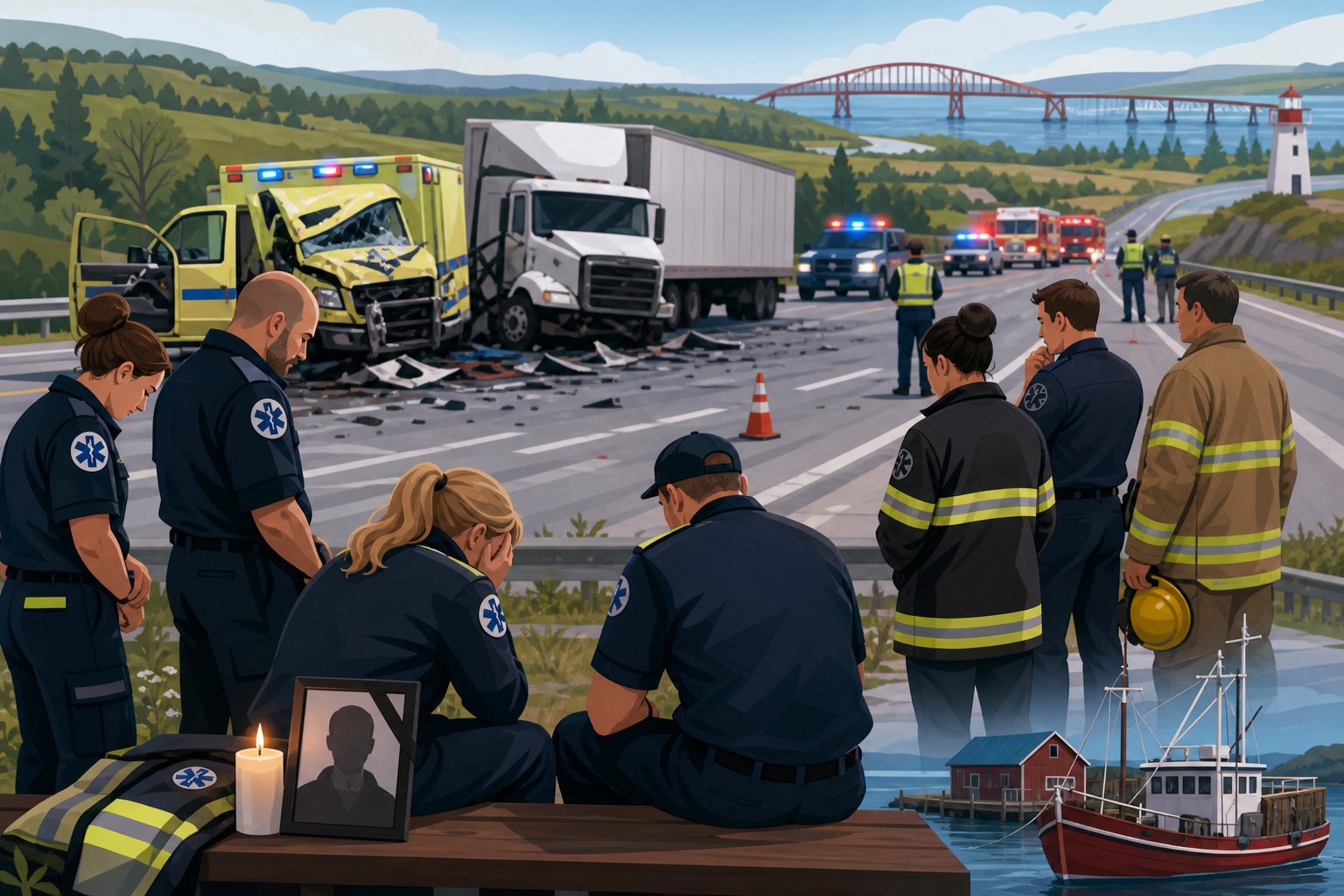
The collision happened on the Trans-Canada Highway just outside Moncton. A 56-year-old Island EMS paramedic, en route to a call, dead after the ambulance he was riding in collided with a transport truck. The details of how that happened are still being sorted out by New Brunswick RCMP. What won't need sorting is what comes after: P.E.I.'s small first-responder community has lost one of its own, and the people still on shift are asking questions nobody trained them to answer.
When the system runs on goodwill
Island EMS operates with roughly 300 paramedics covering an entire province. It's a tight group. You know the people you work with. You know their families. You know who's reliable and who shows up even when the schedule gives them an out. By every account from colleagues and friends, the paramedic killed Tuesday was the latter. Community-minded. Dedicated. The kind of person whose reputation sits on what they did, not what they said they would do.
That matters more on P.E.I. than it would in a larger system. There's no deep bench. When someone that reliable disappears from the roster, the hole doesn't get filled by reassignment. It gets filled by whoever's left working longer, picking up extra shifts, running calls on less sleep. The system already leans hard on goodwill. It just got leaner.
The question nobody's answering
The immediate response has been what you'd expect: grief, support, public statements from officials. Premier Dennis King and Health Minister Mark McLane both issued condolences. Island EMS released a short statement acknowledging the loss. None of that is empty. It's what you do when someone dies doing the job.
What's harder to find is an answer to the structural question now sitting in every station on the Island: what changes? Paramedics already work in a high-risk environment. Vehicle collisions are not rare. Fatigue is common. The call volume has been climbing for years while staffing has not kept pace. A paramedic dying in the line of duty does not, by itself, fix any of that. It just makes the people still on the road more aware of what the stakes actually are.
P.E.I. has been dealing with health-care capacity problems for years. Emergency room closures, physician shortages, surgical backlogs. Ambulance service sits downstream of all that. When ERs close or wait times blow out, paramedics spend more time on calls, more time in hospital hallways waiting to transfer patients, more hours on the clock. The workload compounds. The fatigue compounds.
What the grief exposes
A death like this strips away the usual bureaucratic padding around the question of what a community can reasonably ask of its first responders. The paramedic who died Tuesday wasn't cut corners. He was answering a call. That's the job. But when the job kills someone, and the system that sent them out is already stretched past what anyone would call sustainable, "that's the job" stops being an adequate answer.
The P.E.I. first-responder community is small enough that this death will be felt personally by nearly everyone in it. What they do with that feeling over the next weeks and months will matter. Grief is one thing. The harder part is deciding whether this changes the conversation about staffing, hours, vehicle safety, mental health supports, and what happens when the province asks more of its paramedics than it's built the infrastructure to support.
Nobody's announced a review. Nobody's promised new hiring. For now, the system keeps running the way it ran last week, minus one paramedic who won't be there to pick up the next shift.



The collision happened on the Trans-Canada Highway just outside Moncton. A 56-year-old Island EMS paramedic, en route to a call, dead after the ambulance he was riding in collided with a transport truck. The details of how that happened are still being sorted out by New Brunswick RCMP. What won't need sorting is what comes after: P.E.I.'s small first-responder community has lost one of its own, and the people still on shift are asking questions nobody trained them to answer.
When the system runs on goodwill
Island EMS operates with roughly 300 paramedics covering an entire province. It's a tight group. You know the people you work with. You know their families. You know who's reliable and who shows up even when the schedule gives them an out. By every account from colleagues and friends, the paramedic killed Tuesday was the latter. Community-minded. Dedicated. The kind of person whose reputation sits on what they did, not what they said they would do.
That matters more on P.E.I. than it would in a larger system. There's no deep bench. When someone that reliable disappears from the roster, the hole doesn't get filled by reassignment. It gets filled by whoever's left working longer, picking up extra shifts, running calls on less sleep. The system already leans hard on goodwill. It just got leaner.
The question nobody's answering
The immediate response has been what you'd expect: grief, support, public statements from officials. Premier Dennis King and Health Minister Mark McLane both issued condolences. Island EMS released a short statement acknowledging the loss. None of that is empty. It's what you do when someone dies doing the job.
What's harder to find is an answer to the structural question now sitting in every station on the Island: what changes? Paramedics already work in a high-risk environment. Vehicle collisions are not rare. Fatigue is common. The call volume has been climbing for years while staffing has not kept pace. A paramedic dying in the line of duty does not, by itself, fix any of that. It just makes the people still on the road more aware of what the stakes actually are.
P.E.I. has been dealing with health-care capacity problems for years. Emergency room closures, physician shortages, surgical backlogs. Ambulance service sits downstream of all that. When ERs close or wait times blow out, paramedics spend more time on calls, more time in hospital hallways waiting to transfer patients, more hours on the clock. The workload compounds. The fatigue compounds.
What the grief exposes
A death like this strips away the usual bureaucratic padding around the question of what a community can reasonably ask of its first responders. The paramedic who died Tuesday wasn't cut corners. He was answering a call. That's the job. But when the job kills someone, and the system that sent them out is already stretched past what anyone would call sustainable, "that's the job" stops being an adequate answer.
The P.E.I. first-responder community is small enough that this death will be felt personally by nearly everyone in it. What they do with that feeling over the next weeks and months will matter. Grief is one thing. The harder part is deciding whether this changes the conversation about staffing, hours, vehicle safety, mental health supports, and what happens when the province asks more of its paramedics than it's built the infrastructure to support.
Nobody's announced a review. Nobody's promised new hiring. For now, the system keeps running the way it ran last week, minus one paramedic who won't be there to pick up the next shift.
Read Next
How to Stack the FHSA, RRSP Home Buyers' Plan, and Land Transfer Rebate Without Leaving $15,000 on the Table
The Kitchener Household That Paid $8,400 More by Choosing the Wrong Equity Tool
Alternative Lenders Push Back on Ottawa's Plan to Regulate Them Like Private Mortgage Funds
Why Most Canadians Wait Too Long to Plan Their Own Death