A Frank Lloyd Wright Protégé Built This Bluffs Ravine Home on a Half-Acre Toronto Lot
The home at 2 Ledge Road sits on land most Toronto buyers will never encounter: a full half-acre of ravine-protected forest with nothing between the house and Lake Ontario but air and canopy. In a city where detached lots average 4,000 square feet and shrinking, this kind of space registers not as luxury but as anachronism.
The architect studied under Frank Lloyd Wright. That training shows in how the building is oriented. Large windows face southeast toward the water, and the roofline stays low enough that the structure reads as part of the landscape rather than a pronouncement above it. This is the signature move of Wright's Usonian philosophy: the house should settle into its site, not dominate it.
The listing price is $1,999,999, which positions it just below the psychological threshold that triggers Toronto's combined municipal and provincial land transfer tax of roughly $72,950. That number also skirts the $2 million filter on real estate search platforms, a tactic designed to capture buyers who've set their ceiling at eight digits but might stretch for the right property. The tactic often works. The final sale price in cases like this routinely climbs higher once competing offers surface.
What Half an Acre Actually Means in Toronto
A half-acre lot within Toronto city limits is not just rare. It is functionally extinct in most neighborhoods. Cliffcrest, perched on the eastern edge of Scarborough along the Bluffs, is one of the last pockets where this kind of holding still exists. The reason is geological. The ravine system that runs through the area falls under the jurisdiction of the Toronto and Region Conservation Authority, which restricts both development and subdivision. You cannot easily carve this lot into three narrow infills. The land is protected, and that protection is what makes it valuable.
For context, the Scarborough Bluffs stretch about 15 kilometers along the Lake Ontario shoreline, with cliffs reaching heights of 90 meters. Properties that sit on or near the edge carry an implicit trade: unmatched views in exchange for erosion management and setback restrictions that limit where you can build or expand. The TRCA enforces those setbacks strictly. Any renovation or addition requires permits that account for long-term shoreline stability.
The Wright Lineage as a Market Signal
Homes designed by architects who trained at Taliesin (Wright's apprentice program) hold value differently than builder-grade modern homes. The lineage functions as a form of provenance. Buyers who seek these properties are often looking for something closer to an architectural artifact than a house. That creates a narrow but durable market. The risk is in the renovation. Heavy-handed updates strip the features that provide the home's primary value. Original stone, wood, and the deliberate integration of indoor and outdoor space are what the next buyer will pay for, not a white-box gut job.
The irony is that this kind of property offers what Toronto's Missing Middle housing policies are trying to replicate in denser formats: the feeling of living outside the city while remaining within it. You can reach the Financial District in 20 to 30 minutes via GO Transit from Scarborough or Eglinton stations, but the view from the windows suggests cottage country. That duality is harder to manufacture than a luxury interior.
What makes 2 Ledge Road unusual is not just the space. It's the impossibility of replicating it. Ravine lots of this size are not being created. Bluffs properties with sightlines to the lake are fixed inventory. The architecture is either preserved or lost. The listing is not selling a house. It is selling the last units of a category that has already closed.


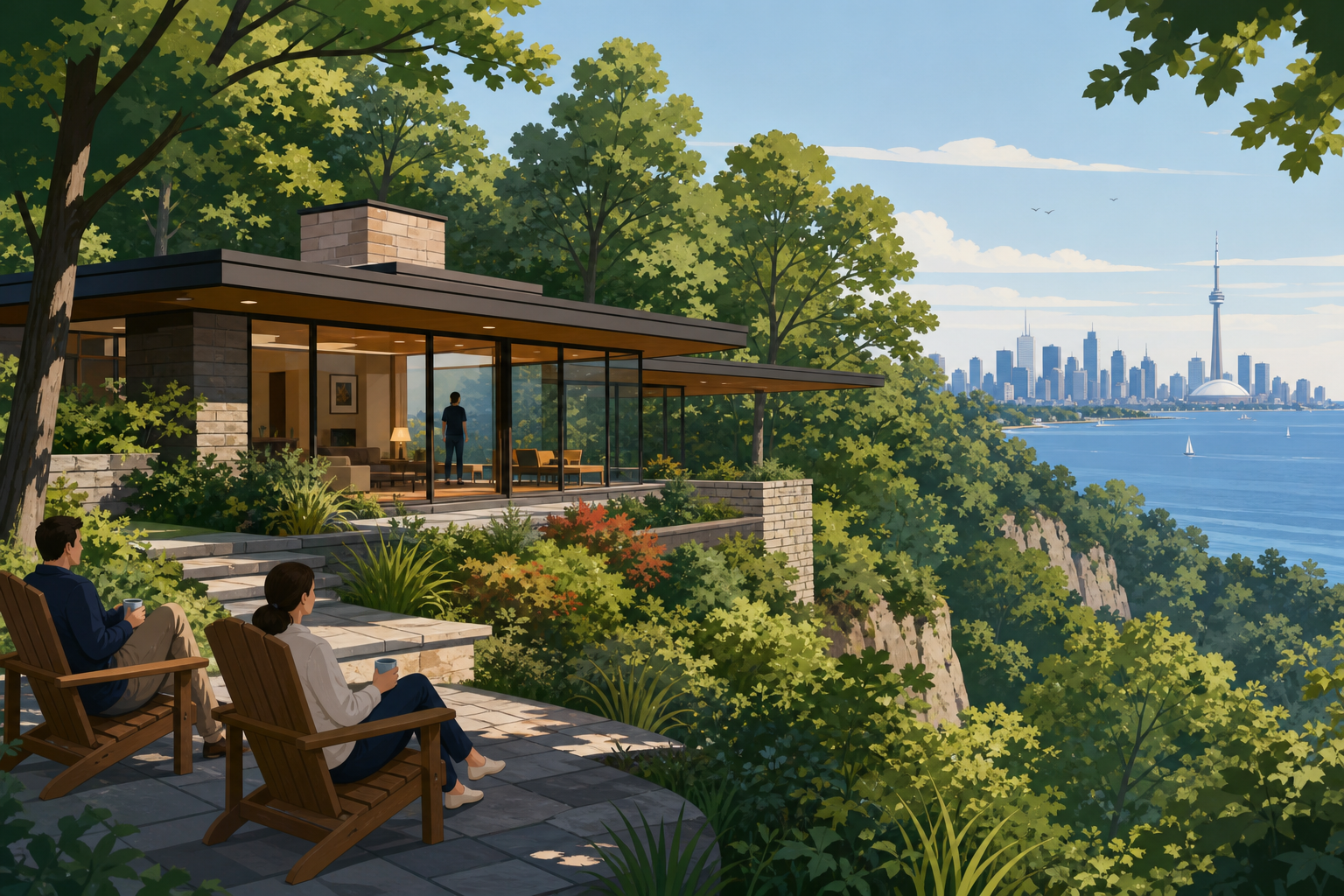

The home at 2 Ledge Road sits on land most Toronto buyers will never encounter: a full half-acre of ravine-protected forest with nothing between the house and Lake Ontario but air and canopy. In a city where detached lots average 4,000 square feet and shrinking, this kind of space registers not as luxury but as anachronism.
The architect studied under Frank Lloyd Wright. That training shows in how the building is oriented. Large windows face southeast toward the water, and the roofline stays low enough that the structure reads as part of the landscape rather than a pronouncement above it. This is the signature move of Wright's Usonian philosophy: the house should settle into its site, not dominate it.
The listing price is $1,999,999, which positions it just below the psychological threshold that triggers Toronto's combined municipal and provincial land transfer tax of roughly $72,950. That number also skirts the $2 million filter on real estate search platforms, a tactic designed to capture buyers who've set their ceiling at eight digits but might stretch for the right property. The tactic often works. The final sale price in cases like this routinely climbs higher once competing offers surface.
What Half an Acre Actually Means in Toronto
A half-acre lot within Toronto city limits is not just rare. It is functionally extinct in most neighborhoods. Cliffcrest, perched on the eastern edge of Scarborough along the Bluffs, is one of the last pockets where this kind of holding still exists. The reason is geological. The ravine system that runs through the area falls under the jurisdiction of the Toronto and Region Conservation Authority, which restricts both development and subdivision. You cannot easily carve this lot into three narrow infills. The land is protected, and that protection is what makes it valuable.
For context, the Scarborough Bluffs stretch about 15 kilometers along the Lake Ontario shoreline, with cliffs reaching heights of 90 meters. Properties that sit on or near the edge carry an implicit trade: unmatched views in exchange for erosion management and setback restrictions that limit where you can build or expand. The TRCA enforces those setbacks strictly. Any renovation or addition requires permits that account for long-term shoreline stability.
The Wright Lineage as a Market Signal
Homes designed by architects who trained at Taliesin (Wright's apprentice program) hold value differently than builder-grade modern homes. The lineage functions as a form of provenance. Buyers who seek these properties are often looking for something closer to an architectural artifact than a house. That creates a narrow but durable market. The risk is in the renovation. Heavy-handed updates strip the features that provide the home's primary value. Original stone, wood, and the deliberate integration of indoor and outdoor space are what the next buyer will pay for, not a white-box gut job.
The irony is that this kind of property offers what Toronto's Missing Middle housing policies are trying to replicate in denser formats: the feeling of living outside the city while remaining within it. You can reach the Financial District in 20 to 30 minutes via GO Transit from Scarborough or Eglinton stations, but the view from the windows suggests cottage country. That duality is harder to manufacture than a luxury interior.
What makes 2 Ledge Road unusual is not just the space. It's the impossibility of replicating it. Ravine lots of this size are not being created. Bluffs properties with sightlines to the lake are fixed inventory. The architecture is either preserved or lost. The listing is not selling a house. It is selling the last units of a category that has already closed.
Read Next
DLC Now Controls Both Filogix and Velocity: Why That Should Worry Every Independent Broker
MCAN's 19% earnings jump proves mortgage impairments aren't the risk signal investors think they are
Toronto Buyers Can Stop Writing Love Letters, The Market Already Did the Work
25 States Sue Trump Over Tariffs, Claiming Presidential Overreach on Import Taxes