7 tax traps Americans face when buying Canadian real estate
The foreign buyer ban extended through 2027 means most Americans can't buy residential property in Toronto, Vancouver, or Montreal right now unless they're permanent residents or hold specific work permits. That restriction is obvious. The tax consequences of buying Canadian real estate as a U.S. citizen are not.
Here's what catches people.
1. File a Canadian tax return even if you never rent the property out.
The Underused Housing Tax charges 1% annually on the assessed value of vacant or underused residential property owned by non-residents. A $600,000 condo costs you $6,000 a year in UHT if you don't file the exemption form proving you occupied it at least 180 days. The filing is separate from your income tax return. Miss it and the penalty is the greater of $5,000 or 5% of the tax owing.
2. The IRS doesn't recognize your principal residence exemption the way Canada does.
Canada lets you sell your primary home tax-free. The IRS caps your exclusion at $250,000 if you're single, $500,000 if married filing jointly. Buy a house in Victoria for $700,000, live in it for five years, sell it for $1.2 million. Canada sees zero taxable gain. The IRS sees a $500,000 gain, taxes you on $200,000 of it (the amount over the exclusion), and collects roughly $40,000 to $60,000 depending on your bracket.
3. You're taxed on phantom currency gains when the Canadian dollar strengthens.
You buy at par, sell at par in Canadian dollars. But if the loonie appreciated 15% against the USD during your holding period, the IRS calculates your proceeds in U.S. dollars and sees a taxable gain. You can break even in real terms and still owe tax. This works in reverse if the CAD weakens, but most Americans don't track the exchange rate at purchase and get caught at sale.
4. The buyer withholds 25% of your sale price until you get a Certificate of Compliance.
When a non-resident sells Canadian real estate, the buyer is legally required to withhold 25% of the gross sale price and remit it to the Canada Revenue Agency under Section 116. You don't get that money until the CRA issues a Certificate of Compliance confirming your tax obligation. On a $900,000 sale, $225,000 sits with the government for months. Apply for the certificate before closing or expect to wait 6 to 18 months for the refund.
5. You have to file FBAR if your Canadian bank accounts exceed $10,000 USD.
The Report of Foreign Bank and Financial Accounts isn't optional. If the aggregate value of your non-U.S. accounts, checking, savings, the account where you pay your mortgage from, hits $10,000 at any point in the year, you file FinCEN Form 114 by April 15. The penalty for non-willful failure is $10,000 per violation. For willful failure, it's the greater of $100,000 or 50% of the account balance. Per year.
6. Provincial vacancy taxes stack on top of the federal UHT.
British Columbia charges a 2% Speculation and Vacancy Tax on properties in designated regions. Toronto has its own 1% Vacant Home Tax. Both operate on different definitions of "occupancy" than the federal UHT. You can satisfy the federal filing and still owe the provincial or municipal levy. A $750,000 Vancouver property generates $15,000 in provincial tax plus $7,500 in federal UHT if left empty.
7. Your TFSA down payment savings are fully taxable in the U.S.
Canadians use Tax-Free Savings Accounts to shelter investment gains. The IRS doesn't recognize TFSAs as tax-exempt. Every dollar of growth inside a TFSA is reportable income on your U.S. return. If you're an American living in Canada and you saved $40,000 in a TFSA that grew to $53,000, the IRS wants tax on the $13,000 gain. Use a non-registered account or expect to file Form 3520 and pay U.S. tax on what Canada calls tax-free.
Most people skip #4 and lose access to their sale proceeds for over a year.


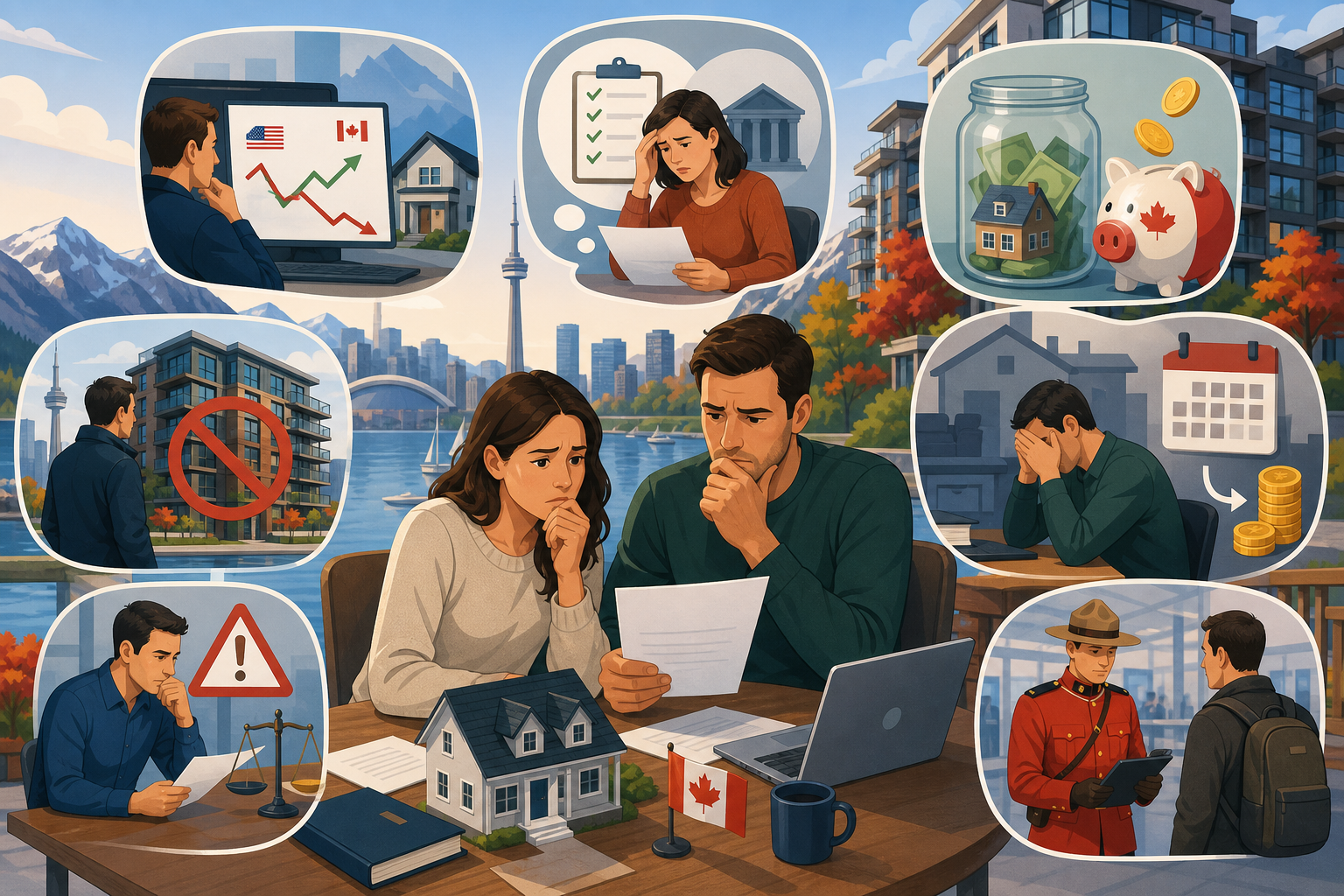

The foreign buyer ban extended through 2027 means most Americans can't buy residential property in Toronto, Vancouver, or Montreal right now unless they're permanent residents or hold specific work permits. That restriction is obvious. The tax consequences of buying Canadian real estate as a U.S. citizen are not.
Here's what catches people.
1. File a Canadian tax return even if you never rent the property out.
The Underused Housing Tax charges 1% annually on the assessed value of vacant or underused residential property owned by non-residents. A $600,000 condo costs you $6,000 a year in UHT if you don't file the exemption form proving you occupied it at least 180 days. The filing is separate from your income tax return. Miss it and the penalty is the greater of $5,000 or 5% of the tax owing.
2. The IRS doesn't recognize your principal residence exemption the way Canada does.
Canada lets you sell your primary home tax-free. The IRS caps your exclusion at $250,000 if you're single, $500,000 if married filing jointly. Buy a house in Victoria for $700,000, live in it for five years, sell it for $1.2 million. Canada sees zero taxable gain. The IRS sees a $500,000 gain, taxes you on $200,000 of it (the amount over the exclusion), and collects roughly $40,000 to $60,000 depending on your bracket.
3. You're taxed on phantom currency gains when the Canadian dollar strengthens.
You buy at par, sell at par in Canadian dollars. But if the loonie appreciated 15% against the USD during your holding period, the IRS calculates your proceeds in U.S. dollars and sees a taxable gain. You can break even in real terms and still owe tax. This works in reverse if the CAD weakens, but most Americans don't track the exchange rate at purchase and get caught at sale.
4. The buyer withholds 25% of your sale price until you get a Certificate of Compliance.
When a non-resident sells Canadian real estate, the buyer is legally required to withhold 25% of the gross sale price and remit it to the Canada Revenue Agency under Section 116. You don't get that money until the CRA issues a Certificate of Compliance confirming your tax obligation. On a $900,000 sale, $225,000 sits with the government for months. Apply for the certificate before closing or expect to wait 6 to 18 months for the refund.
5. You have to file FBAR if your Canadian bank accounts exceed $10,000 USD.
The Report of Foreign Bank and Financial Accounts isn't optional. If the aggregate value of your non-U.S. accounts, checking, savings, the account where you pay your mortgage from, hits $10,000 at any point in the year, you file FinCEN Form 114 by April 15. The penalty for non-willful failure is $10,000 per violation. For willful failure, it's the greater of $100,000 or 50% of the account balance. Per year.
6. Provincial vacancy taxes stack on top of the federal UHT.
British Columbia charges a 2% Speculation and Vacancy Tax on properties in designated regions. Toronto has its own 1% Vacant Home Tax. Both operate on different definitions of "occupancy" than the federal UHT. You can satisfy the federal filing and still owe the provincial or municipal levy. A $750,000 Vancouver property generates $15,000 in provincial tax plus $7,500 in federal UHT if left empty.
7. Your TFSA down payment savings are fully taxable in the U.S.
Canadians use Tax-Free Savings Accounts to shelter investment gains. The IRS doesn't recognize TFSAs as tax-exempt. Every dollar of growth inside a TFSA is reportable income on your U.S. return. If you're an American living in Canada and you saved $40,000 in a TFSA that grew to $53,000, the IRS wants tax on the $13,000 gain. Use a non-registered account or expect to file Form 3520 and pay U.S. tax on what Canada calls tax-free.
Most people skip #4 and lose access to their sale proceeds for over a year.
Read Next
MCAN's 19% earnings jump proves mortgage impairments aren't the risk signal investors think they are
Toronto Buyers Can Stop Writing Love Letters, The Market Already Did the Work
25 States Sue Trump Over Tariffs, Claiming Presidential Overreach on Import Taxes
Carney's Alberta housing pitch meets canola fields and separatist flags