7 Closing Costs Ontario First-Time Buyers Face in 2026: Worked Examples at $500K, $700K and $900K
You have saved $65,000. The seller accepted your offer on a $650,000 semi in Etobicoke. Your real estate agent congratulates you. Then your lawyer sends the final closing statement and the number at the bottom is $22,400, not including your down payment.
That gap between what you saved and what you actually need on closing day derails more first-time purchases in Ontario than any other single factor. Ratehub reported in May 2026 that buyers should budget 1.5 to 4 percent of the purchase price for closing costs, yet most arrive at the lawyer's office having planned for zero. The percentage swings based on purchase price, down payment size, and whether you are buying resale or new construction. Below is the itemized breakdown, with real numbers at three price points so you can build your own closing budget before you make an offer.
Land Transfer Tax: Your Largest Single Closing Expense
Ontario charges provincial land transfer tax on every property transfer. The rate is marginal
7 Closing Costs Ontario First-Time Buyers Face in 2026: Worked Examples at $500K, $700K and $900K
Your lawyer calls three days before closing. The final number is $18,300 in cash, due at 2 PM on Thursday, separate from your down payment. You have $14,000 liquid.
The phone call that kills deals is never about the mortgage rate. It's about the stack of smaller charges that don't go into the mortgage and can't be paid with a credit card. Below are the seven line items that show up on every Ontario closing statement, with exact dollar figures at three price points and the specific traps that catch people who budgeted only for the down payment.
1. Provincial Land Transfer Tax (After the $4,000 Rebate)
Ontario's land transfer tax runs on a marginal scale: 0.5% on the first $55,000, then 1% up to $250,000, then 1.5% up to $400,000, then 2% above that. First-time buyers get a provincial rebate of up to $4,000, which covers the full tax on properties up to roughly $368,000. Above that, you pay the difference.
At $500,000: Total provincial LTT is $6,475. After the $4,000 rebate, you owe $2,475. At $700,000: Total LTT is $10,475. After rebate: $6,475. At $900,000: Total LTT is $14,475. After rebate: $10,475.
If you're buying in Toronto, add a second municipal land transfer tax at the same marginal rates. The city offers its own rebate (also up to $4,000), but you're still paying double on the portion above $368,000. A $700,000 house in Toronto means $12,950 in combined LTT after both rebates.
The rebate only applies if neither you nor your spouse has ever owned property anywhere in the world. Co-buying with a parent who owned a cottage in 1987 disqualifies you.
2. Legal Fees and Disbursements
A real estate lawyer is mandatory in Ontario. The lawyer handles the title search, registers the deed, verifies the mortgage instructions, and prepares the Statement of Adjustments. Fees in 2026 range from $1,200 to $2,500 depending on complexity and region, plus disbursements (title search fees, registration costs, courier charges) of $300 to $600.
Budget $1,500 to $2,800 total. Get a quote upfront. Some lawyers advertise $999 flat fees and then bill $800 in disbursements.
3. Title Insurance
Most lenders require title insurance to protect against fraud, survey errors, encroachments, and missed liens. This is a one-time premium paid at closing, typically $300 to $900 depending on the property value. It covers both the lender's interest and, if you buy an owner's policy (which you should), your equity.
Budget $500 to $900. The policy lasts as long as you or your heirs hold an interest in the property.
4. Home Inspection
Not legally required, but skipping it is how you buy a $650,000 house with a $40,000 foundation crack. Inspections cost $450 to $700 for a standard detached or semi, more for older homes or properties with outbuildings.
Budget $600. Pay this before closing, but it comes out of the same savings pool.
5. Appraisal Fee
If you're financing more than 80% of the purchase price, the lender will order an appraisal to confirm the property is worth what you're paying. The fee is $300 to $500 and is paid upfront, often by credit card to the appraisal company directly.
Budget $400. If the appraisal comes in low, you'll need extra cash to cover the gap between the appraised value and your purchase price, which does not show up on this list but has killed more deals in 2026 than any single line item.
6. CMHC Insurance Premium (and the 8% Ontario Portion You Pay at Closing)
If your down payment is under 20%, you pay for mortgage default insurance through CMHC, Sagen, or Canada Guaranty. The premium is a percentage of the loan amount, added to your mortgage, so you don't pay it upfront. But Ontario charges 8% provincial sales tax on that premium, and that portion is due in cash at closing.
At $500,000 with 10% down ($50,000): Loan is $450,000. CMHC premium at 3.10% is $13,950. Ontario's 8% of that premium is $1,116 due at closing. At $700,000 with 10% down: Loan is $630,000. Premium at 3.10% is $19,530. Tax: $1,562. At $900,000 with 10% down: Loan is $810,000. Premium at 2.80% is $22,680. Tax: $1,814.
This tax does not go into the mortgage. It's cash, due the day you close.
7. Property Tax Adjustment and Prepaid Utility Adjustments
The Statement of Adjustments will include a credit or debit for property taxes the seller prepaid beyond the closing date, plus adjustments for prepaid utilities, rental water heaters, or oil tank rentals. These are usually small (a few hundred dollars) but occasionally large if the seller prepaid the full year of property taxes in January and you're closing in February.
Budget $200 to $800 as a placeholder. Your lawyer will calculate the exact figure.
Real Numbers at Three Price Points
Purchase Price
Down Payment (10%)
Provincial LTT (Post-Rebate)
Legal + Disbursements
Title Insurance
Inspection
Appraisal
CMHC Tax (8% ON Portion)
Adjustments (Est.)
Total Closing Costs
$500,000
$50,000
$2,475
$1,800
$600
$600
$400
$1,116
$400
$7,391
$700,000
$70,000
$6,475
$2,000
$700
$600
$400
$1,562
$500
$12,237
$900,000
$90,000
$10,475
$2,200
$800
$700
$400
$1,814
$600
$16,989
These figures assume resale properties outside Toronto, 10% down, and standard inspections. Add another $6,000 to $7,000 in LTT if you're buying inside Toronto city limits.
The line item that catches the most people is #6. The CMHC premium itself gets rolled into the mortgage, so buyers assume the entire cost is financed. The Ontario tax on that premium is not. It's due at closing, in cash, and it doesn't show up in most closing cost estimates because it's buried in provincial insurance tax rules.


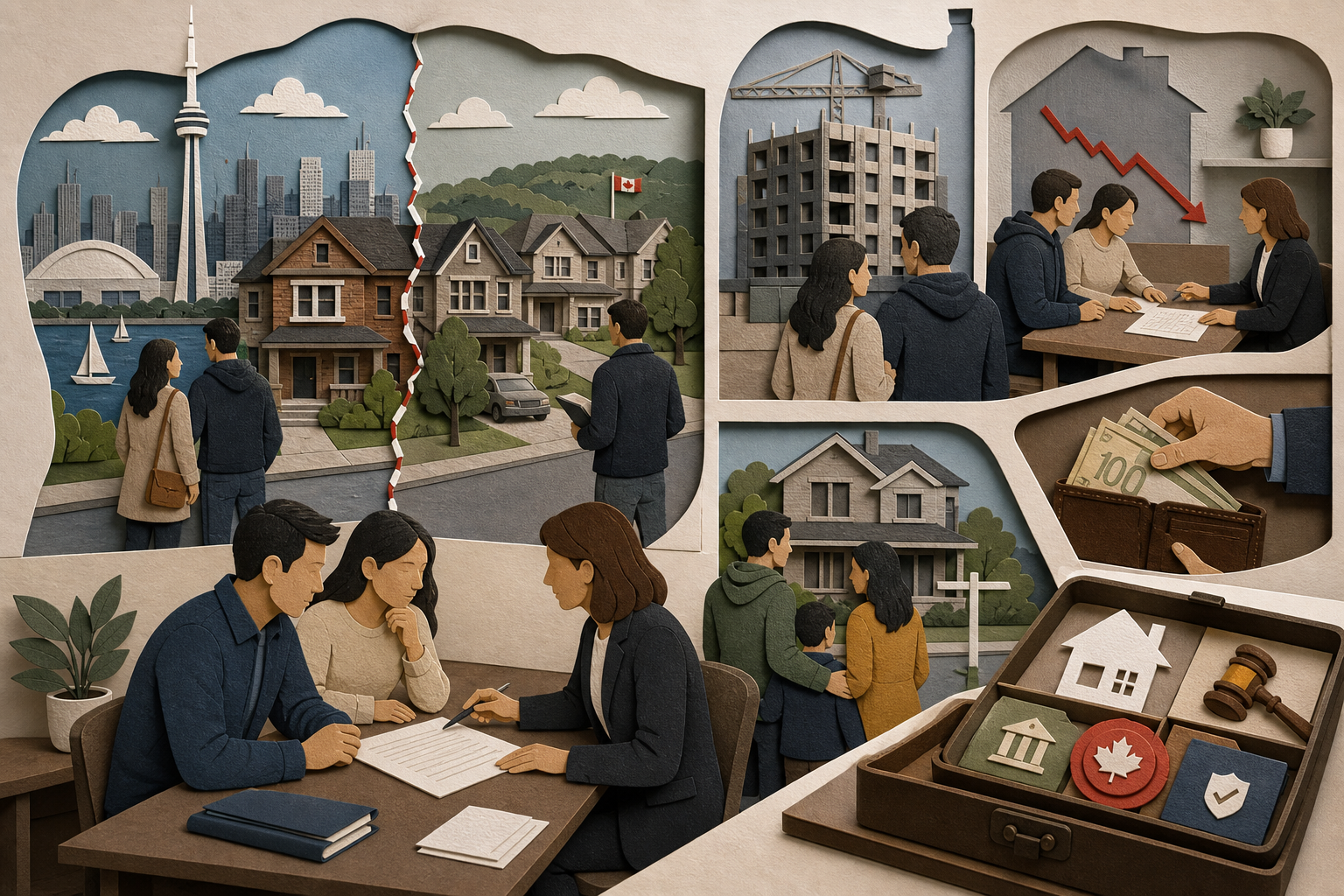

You have saved $65,000. The seller accepted your offer on a $650,000 semi in Etobicoke. Your real estate agent congratulates you. Then your lawyer sends the final closing statement and the number at the bottom is $22,400, not including your down payment.
That gap between what you saved and what you actually need on closing day derails more first-time purchases in Ontario than any other single factor. Ratehub reported in May 2026 that buyers should budget 1.5 to 4 percent of the purchase price for closing costs, yet most arrive at the lawyer's office having planned for zero. The percentage swings based on purchase price, down payment size, and whether you are buying resale or new construction. Below is the itemized breakdown, with real numbers at three price points so you can build your own closing budget before you make an offer.
Land Transfer Tax: Your Largest Single Closing Expense
Ontario charges provincial land transfer tax on every property transfer. The rate is marginal
7 Closing Costs Ontario First-Time Buyers Face in 2026: Worked Examples at $500K, $700K and $900K
Your lawyer calls three days before closing. The final number is $18,300 in cash, due at 2 PM on Thursday, separate from your down payment. You have $14,000 liquid.
The phone call that kills deals is never about the mortgage rate. It's about the stack of smaller charges that don't go into the mortgage and can't be paid with a credit card. Below are the seven line items that show up on every Ontario closing statement, with exact dollar figures at three price points and the specific traps that catch people who budgeted only for the down payment.
1. Provincial Land Transfer Tax (After the $4,000 Rebate)
Ontario's land transfer tax runs on a marginal scale: 0.5% on the first $55,000, then 1% up to $250,000, then 1.5% up to $400,000, then 2% above that. First-time buyers get a provincial rebate of up to $4,000, which covers the full tax on properties up to roughly $368,000. Above that, you pay the difference.
At $500,000: Total provincial LTT is $6,475. After the $4,000 rebate, you owe $2,475.
At $700,000: Total LTT is $10,475. After rebate: $6,475.
At $900,000: Total LTT is $14,475. After rebate: $10,475.
If you're buying in Toronto, add a second municipal land transfer tax at the same marginal rates. The city offers its own rebate (also up to $4,000), but you're still paying double on the portion above $368,000. A $700,000 house in Toronto means $12,950 in combined LTT after both rebates.
The rebate only applies if neither you nor your spouse has ever owned property anywhere in the world. Co-buying with a parent who owned a cottage in 1987 disqualifies you.
2. Legal Fees and Disbursements
A real estate lawyer is mandatory in Ontario. The lawyer handles the title search, registers the deed, verifies the mortgage instructions, and prepares the Statement of Adjustments. Fees in 2026 range from $1,200 to $2,500 depending on complexity and region, plus disbursements (title search fees, registration costs, courier charges) of $300 to $600.
Budget $1,500 to $2,800 total. Get a quote upfront. Some lawyers advertise $999 flat fees and then bill $800 in disbursements.
3. Title Insurance
Most lenders require title insurance to protect against fraud, survey errors, encroachments, and missed liens. This is a one-time premium paid at closing, typically $300 to $900 depending on the property value. It covers both the lender's interest and, if you buy an owner's policy (which you should), your equity.
Budget $500 to $900. The policy lasts as long as you or your heirs hold an interest in the property.
4. Home Inspection
Not legally required, but skipping it is how you buy a $650,000 house with a $40,000 foundation crack. Inspections cost $450 to $700 for a standard detached or semi, more for older homes or properties with outbuildings.
Budget $600. Pay this before closing, but it comes out of the same savings pool.
5. Appraisal Fee
If you're financing more than 80% of the purchase price, the lender will order an appraisal to confirm the property is worth what you're paying. The fee is $300 to $500 and is paid upfront, often by credit card to the appraisal company directly.
Budget $400. If the appraisal comes in low, you'll need extra cash to cover the gap between the appraised value and your purchase price, which does not show up on this list but has killed more deals in 2026 than any single line item.
6. CMHC Insurance Premium (and the 8% Ontario Portion You Pay at Closing)
If your down payment is under 20%, you pay for mortgage default insurance through CMHC, Sagen, or Canada Guaranty. The premium is a percentage of the loan amount, added to your mortgage, so you don't pay it upfront. But Ontario charges 8% provincial sales tax on that premium, and that portion is due in cash at closing.
At $500,000 with 10% down ($50,000): Loan is $450,000. CMHC premium at 3.10% is $13,950. Ontario's 8% of that premium is $1,116 due at closing.
At $700,000 with 10% down: Loan is $630,000. Premium at 3.10% is $19,530. Tax: $1,562.
At $900,000 with 10% down: Loan is $810,000. Premium at 2.80% is $22,680. Tax: $1,814.
This tax does not go into the mortgage. It's cash, due the day you close.
7. Property Tax Adjustment and Prepaid Utility Adjustments
The Statement of Adjustments will include a credit or debit for property taxes the seller prepaid beyond the closing date, plus adjustments for prepaid utilities, rental water heaters, or oil tank rentals. These are usually small (a few hundred dollars) but occasionally large if the seller prepaid the full year of property taxes in January and you're closing in February.
Budget $200 to $800 as a placeholder. Your lawyer will calculate the exact figure.
Real Numbers at Three Price Points
These figures assume resale properties outside Toronto, 10% down, and standard inspections. Add another $6,000 to $7,000 in LTT if you're buying inside Toronto city limits.
The line item that catches the most people is #6. The CMHC premium itself gets rolled into the mortgage, so buyers assume the entire cost is financed. The Ontario tax on that premium is not. It's due at closing, in cash, and it doesn't show up in most closing cost estimates because it's buried in provincial insurance tax rules.
Read Next
DLC Now Controls Both Filogix and Velocity: Why That Should Worry Every Independent Broker
MCAN's 19% earnings jump proves mortgage impairments aren't the risk signal investors think they are
Toronto Buyers Can Stop Writing Love Letters, The Market Already Did the Work
25 States Sue Trump Over Tariffs, Claiming Presidential Overreach on Import Taxes